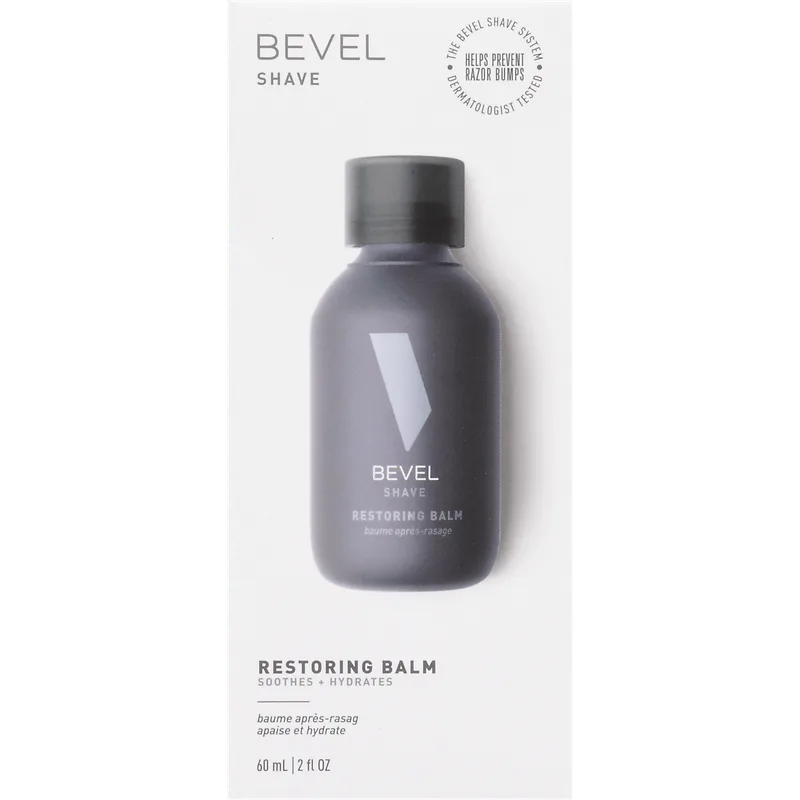
Bevel
Restoring Balm (2020 formulation)
Aftershavetypically under $12

Cleaner pick · Safest shave we have rated
Barrister and Mann
Unscented Shaving Soap (Vegan)+74 on ingredient safety
$22.99
Ingredient safetyRaters agree
Ranked by safety only. Greenlens earns from qualifying purchases. Payout never affects a rating, a ranking, or the cleaner pick.
Raters split
Ingredient safety
A 82-point gap between the two loudest voices.
0ANSES Endocrine DisruptorsGovernment
vs82IARC MonographsGovernment
050100
See why, ingredient by ingredientAll 1116 cleaner options, safest first We show the best 12, including the strongest on each axis.
Every rater, every axis
Ingredient safety
82 pts apartIndependent — not funded by the brands it rates. Auto-linked to this product, not yet human-reviewed. Checked this week. about this rater →
Independent — not funded by the brands it rates. Auto-linked to this product, not yet human-reviewed. Checked this week. about this rater →
A government authority. Auto-linked to this product, not yet human-reviewed. Checked this week. about this rater →
Independent — not funded by the brands it rates. Auto-linked to this product, not yet human-reviewed. Checked this week. about this rater →
A government authority. Auto-linked to this product, not yet human-reviewed. Checked this week. about this rater →
A government authority. Auto-linked to this product, not yet human-reviewed. Checked this week. about this rater →
A government authority. Auto-linked to this product, not yet human-reviewed. Checked this week. about this rater →
Also screened, nothing found: US NTP Report on Carcinogens · ECHA SVHC Candidate List · California Proposition 65
Environmental
Also screened, nothing found: EU Microplastics Restriction
Labor
Run by a nonprofit. Auto-linked to this product, not yet human-reviewed. This rates Bevel as a company and applies to everything they make, not this product alone. Checked this week. about this rater →
Coverage & match quality
8 ratings · 2 of 4 axes
- Some ratings rest on an automatic match that has not been human-reviewed.
- Fewer raters reach smaller-brand products, so a missing rating is not a clean bill of health, only a gap.
Weighted by what you care about
Tune your weights
composite recomputes live
+
1.0×
Environmentalno rating
No rater covers this axis for this product, so its weight can't move the score.
1.0×
Packagingno rating
No rater covers this axis for this product, so its weight can't move the score.
0 means ignored. Higher = more weight in your composite.
Ingredients, decoded
Data availability
Robust48 of 49 characterized
Our sources have reference data on 48 of 49 listed ingredients; 1 is uncharacterized in our data — a gap, not a clean bill.
Worth a look (15)
ANSES CMR-listedflagged by 3 of 9 lists →
ANSES endocrine candidateflagged by 3 of 9 lists →
ANSES endocrine candidateflagged by 3 of 9 lists →
EU harmonised CMR (cat. 2)flagged by 4 of 9 lists →
ANSES endocrine candidateflagged by 2 of 9 lists →
ANSES endocrine candidateflagged by 2 of 9 lists →
EU harmonised skin sensitizerflagged by 2 of 9 lists →
EU harmonised skin sensitizerflagged by 2 of 9 lists →
Undisclosed fragrance blendflagged by 2 of 9 lists →
Health Canada Hotlist — restrictedflagged by 1 of 9 lists →
EU-regulated fragrance allergenflagged by 1 of 9 lists →
IARC possible carcinogen (Group 2B)flagged by 1 of 9 lists →
- MELALEUCA ALTERNIFOLIA LEAF OILcommon irritantfragrance materialperfuming · antioxidantraters disagree
Mild sensitizer for someflagged by 1 of 9 lists →
EU-restricted (with limits)flagged by 2 of 9 lists →
Mild sensitizer for someflagged by 1 of 9 lists →
No flags in our sources (33)
- WATER
- BUTYLENE GLYCOL
- SORBITOL
- BUTYROSPERMUM PARKII BUTTER
- GLYCERYL STEARATE
- PEG-100 STEARATE
- GLYCERINhumectant
- PANTHENOLhumectantsoothing
- NIACINAMIDEsoothing
- SODIUM ASCORBYL PHOSPHATE
- ALLANTOINsoothing
- ARGANIA SPINOSA KERNEL OIL
- TOCOPHERYL ACETATE
- SIMMONDSIA CHINENSIS SEED OIL
- DIMETHICONErich occlusive
- BISABOLOLsoothing
- HAMAMELIS VIRGINIANA BARK/LEAF/TWIG EXTRACT
- HELIANTHUS ANNUUS SEED OIL
- CARTHAMUS TINCTORIUS SEED OILfragrance material
- CALENDULA OFFICINALIS FLOWER EXTRACT
- AVENA SATIVA KERNEL EXTRACTsoothing
- VITIS VINIFERA SEED EXTRACT
- SALIX ALBA BARK EXTRACT
- HELIANTHUS ANNUUS SEED EXTRACT
- PORTULACA OLERACEA EXTRACT
- POLYSORBATE 20
- CETYL ALCOHOL
- LAURETH-4
- STEARIC ACID
- C13-14 ISOPARAFFIN
- LAURETH-7
- CAPRYLYL GLYCOL
- XANTHAN GUM
No data in our sources (1)
Not a verdict — our authorities simply have no reference for these.
What these ingredient tags mean (7)
These describe what an ingredient is, not whether it is a problem. The stance marks above are the ratings; these are not.
common irritantMELALEUCA ALTERNIFOLIA LEAF OIL
- MELALEUCA ALTERNIFOLIA LEAF OIL: An essential oil whose oxidation products carry its sensitising potential; the EU assesses it as a moderate skin sensitiser. SCCS Scientific Opinion on Tea Tree Oil (CAS/EC 68647-73-4 / 285-377-1), SCCS/1681/25, adopted 30 October 2025, which concludes it is a moderate skin sensitiser. It does not set maximum levels of its own: it assesses the concentrations the applicant defended, and finds no concern at 2,0% in shampoo, 1,0% in shower gel, 1,0% in face wash and 0,1% in face cream, for oil conforming to ISO 4730:2017, in adults, in non-sprayable formats. It draws on the earlier SCCP opinions SCCP/1155/08 and SCCP/0843/04 and incorporates their data by reference; it says nothing about their status.
fragrance materialMENTHOL, CITRAL, CITRONELLOL, COUMARIN, LIMONENE, GERANIOL, LINALOOL
- MENTHOL: The cooling component of mint oils, named by the EU as a fragrance substance to be declared on the label. EU Regulation (EC) 1223/2009, Annex III entry 338, inserted by Commission Regulation (EU) 2023/1545: a fragrance substance whose presence must be indicated in the list of ingredients above 0,001% in leave-on and 0,01% in rinse-off products. It is declarable in its OWN right, not by way of any component it carries. The name to look for on a label is "Menthol". The duty applies now. Transition footnote (40) lets stock that does not comply, lawfully placed on the Union market before the 31 July 2026 cut-off, be made available until 31 July 2028.
- CITRAL: A lemon-scented fragrance component named separately on the label; the one name covers three related substances. EU Regulation (EC) 1223/2009, Annex III entry 70: a fragrance substance whose presence must be indicated in the list of ingredients above 0,001% in leave-on and 0,01% in rinse-off products, because of established contact-allergy risk. As replaced by Commission Regulation (EU) 2026/909 of 27 April 2026, the entry is a GROUPED one covering citral, geranial and neral, declared collectively as "Citral", with per-product-type caps from 0,032% in deodorant to 1,2% in rinse-off and leave-on hair products. Its three substances carry two different sell-through dates: products not complying may not be placed on the Union market from 1 January 2027 in every case, and may not be made available from 1 July 2028 for citral, footnote (**), or from 1 August 2028 for geranial and neral, footnote (***). In the consolidated text those two footnotes are renumbered (46) and (47); both are worded "these substances", where the footnotes that attach to a single named substance say "that substance".
- CITRONELLOL: A rose-and-citrus fragrance component named separately on the label. EU Regulation (EC) 1223/2009, Annex III entry 86: a fragrance substance whose presence must be indicated in the list of ingredients above 0,001% in leave-on and 0,01% in rinse-off products, because of established contact-allergy risk.
- COUMARIN: A sweet hay-scented fragrance component named separately on the label. EU Regulation (EC) 1223/2009, Annex III entry 77: a fragrance substance whose presence must be indicated in the list of ingredients above 0,001% in leave-on and 0,01% in rinse-off products, because of established contact-allergy risk.
- LIMONENE: A citrus-smelling fragrance component named separately on the label; the one name covers three related isomers. EU Regulation (EC) 1223/2009, Annex III entry 88: a fragrance substance whose presence must be indicated in the list of ingredients above 0,001% in leave-on and 0,01% in rinse-off products, because of established contact-allergy risk. That entry carries transition footnote (37): stock that does not comply, lawfully placed on the Union market before the 31 July 2026 cut-off, may still be made available until 31 July 2028. It is marked on the racemic dl-limonene/Dipentene line and the (S)-(l-limonene) line, but NOT the (R)-p-mentha-1,8-diene (d-limonene) line, CAS 5989-27-5, whose duty was already running as entry 88 before Commission Regulation (EU) 2023/1545 and so needed no transition. All three isomers are declared under the single glossary name "Limonene", so that name on a label does not identify which of them is present.
- GERANIOL: A rose-scented fragrance component named separately on the label. EU Regulation (EC) 1223/2009, Annex III entry 78: a fragrance substance whose presence must be indicated in the list of ingredients above 0,001% in leave-on and 0,01% in rinse-off products, because of established contact-allergy risk.
- LINALOOL: A floral fragrance component named separately on the label. EU Regulation (EC) 1223/2009, Annex III entry 84: a fragrance substance whose presence must be indicated in the list of ingredients above 0,001% in leave-on and 0,01% in rinse-off products, because of established contact-allergy risk.
undeclared fragrance blendFRAGRANCE
- FRAGRANCE: A blend the label does not itemize, so what is in it cannot be read from the ingredient list. EU Regulation (EC) 1223/2009 permits the collective term "parfum"; the SCCS Opinion on Fragrance Allergens (SCCS/1459/11) reviews the contact-allergy evidence for the substances it can contain.
exfoliating acidLACTIC ACID, SALICYLIC ACID
- LACTIC ACID: An alpha hydroxy acid that loosens surface skin cells; it also makes skin more sun-sensitive while you use it. FDA, "Guidance for Industry: Labeling for Topically Applied Cosmetic Products Containing Alpha Hydroxy Acids as Ingredients" (announced at 70 FR 1721, 10 January 2005; FDA web pages title it "Labeling for Cosmetics Containing Alpha Hydroxy Acids"), which names this acid and recommends the statement "Sunburn Alert: This product contains an alpha hydroxy acid (AHA) that may increase your skin's sensitivity to the sun and particularly the possibility of sunburn."
- SALICYLIC ACID: A beta hydroxy acid that clears the inside of pores; the EU restricts its level and keeps it off children under three. SCCS Opinion on Salicylic Acid, Submission I (SCCS/1601/18, corrigendum of 20 to 21 June 2019); EU Regulation (EC) 1223/2009 Annex III entry 98, as amended by Commission Regulation (EU) 2021/850, which for purposes other than preservation caps it at 3,0% in rinse-off hair products, 2,0% in other products, and 0,5% in body lotion, eye shadow, mascara, eyeliner, lipstick and roll-on deodorant, and states "Not to be used in preparations for children under 3 years of age." Its separate PRESERVATIVE use sits at Annex V entry 3, capped at 0,5% (acid), where the salts carry the carve-out "except for shampoos".
rich occlusiveDIMETHICONE
- DIMETHICONE: A silicone that forms a film on the surface of the skin without an oily feel. FDA OTC skin protectant monograph, 21 CFR 347.10(g), lists dimethicone as a skin protectant at 1 to 30%.
humectantGLYCERIN, PANTHENOL
- GLYCERIN: A humectant, and one of the two ingredients a comparison of moisturiser components found made a significant difference to skin hydration. FDA OTC skin protectant monograph, 21 CFR 347.10(h), lists glycerin as a skin protectant at 20 to 45%. On the humectant half: Jeong CB, Han JY, Cho JC, Suh KD, Nam GW, "Analysis of electrical property changes of skin by oil-in-water emulsion components", Int J Cosmet Sci 2013;35(4):402-410, DOI 10.1111/ics.12059, PMID 23621673, found that "glycerine and urea showed significant skin hydration effects compared with other humectants".
- PANTHENOL: A provitamin B5 humectant used in products aimed at irritated and healing skin. On the humectant half: Ferreira VTP, Silva GC, Martin AA, Maia Campos PMBG, "Topical dexpanthenol effects on physiological parameters of the stratum corneum by Confocal Raman Microspectroscopy", Skin Res Technol 2023;29(9):e13317, DOI 10.1111/srt.13317, PMID 37753694, PMCID PMC10504581, open access, Introduction: "As a humectant, it has been shown to retain water more efficiently than other humectants during the last stages of dehydration..." On the soothing half, which that paper does NOT support: Cho YS, Kim HO, Woo SM, Lee DH, "Use of Dexpanthenol for Atopic Dermatitis—Benefits and Recommendations Based on Current Evidence", J Clin Med 2022;11(14):3943, DOI 10.3390/jcm11143943, PMID 35887707, open access, section 3.5: "To facilitate wound healing, dexpanthenol reduces inflammation, and promotes cell proliferation and epithelial remodeling."
soothingPANTHENOL, NIACINAMIDE, ALLANTOIN, BISABOLOL, AVENA SATIVA KERNEL EXTRACT
- PANTHENOL: A provitamin B5 humectant used in products aimed at irritated and healing skin. On the humectant half: Ferreira VTP, Silva GC, Martin AA, Maia Campos PMBG, "Topical dexpanthenol effects on physiological parameters of the stratum corneum by Confocal Raman Microspectroscopy", Skin Res Technol 2023;29(9):e13317, DOI 10.1111/srt.13317, PMID 37753694, PMCID PMC10504581, open access, Introduction: "As a humectant, it has been shown to retain water more efficiently than other humectants during the last stages of dehydration..." On the soothing half, which that paper does NOT support: Cho YS, Kim HO, Woo SM, Lee DH, "Use of Dexpanthenol for Atopic Dermatitis—Benefits and Recommendations Based on Current Evidence", J Clin Med 2022;11(14):3943, DOI 10.3390/jcm11143943, PMID 35887707, open access, section 3.5: "To facilitate wound healing, dexpanthenol reduces inflammation, and promotes cell proliferation and epithelial remodeling."
- NIACINAMIDE: A vitamin B3 form that supports the skin barrier and has anti-inflammatory activity; it turns up in products aimed at acne, rosacea and eczema. Camillo L, Zavattaro E, Savoia P, "Nicotinamide: A Multifaceted Molecule in Skin Health and Beyond", Medicina (Kaunas) 2025;61(2):254, DOI 10.3390/medicina61020254, PMID 40005371, open access: it "is extensively used in ... the treatment of dermatological conditions such as blistering diseases, atopic dermatitis, rosacea, and acne vulgaris", and contributes to reducing inflammation. On the acne evidence specifically: Liu H, Yu H, Xia J, Liu L, Liu GJ, Sang H, Peinemann F, "Topical azelaic acid, salicylic acid, nicotinamide, sulphur, zinc and fruit acid (alpha-hydroxy acid) for acne", Cochrane Database Syst Rev 2020;5:CD011368, DOI 10.1002/14651858.CD011368.pub2, PMID 32356369, records "low-quality evidence" for every nicotinamide comparison it could pool, and none of its four nicotinamide studies measured the physician global assessment at all.
- ALLANTOIN: A skin protectant used at low levels in products aimed at irritated skin. FDA OTC skin protectant monograph, 21 CFR 347.10(a), lists allantoin as a skin-protectant active at 0,5 to 2%. Its labelled indications are 21 CFR 347.50(b)(1), "temporarily protects minor: cuts, scrapes, burns", and (b)(2), which covers chafed, chapped or cracked skin. The monograph does not give it the "minor skin irritation and itching" wording; that one belongs to colloidal oatmeal, sodium bicarbonate and one combination, and to topical starch without the itching half.
- BISABOLOL: The main soothing component isolated from chamomile. Eddin LB et al., "Health Benefits, Pharmacological Effects, Molecular Mechanisms, and Therapeutic Potential of alpha-Bisabolol", Nutrients 2022;14(7):1370, DOI 10.3390/nu14071370, PMID 35405982, open access: it "is integrated in many cosmetic formulations due to its skin soothing effects, well documented dermal absorption and the absence of dermal irritations or photosensitivity following its application". The EMA HMPC assessment report on Matricaria recutita (EMA/HMPC/55837/2011) discusses its anti-inflammatory data.
- AVENA SATIVA KERNEL EXTRACT: One of the ingredients the FDA recognises by name as an over-the-counter skin protectant for irritation and itching. FDA OTC skin protectant monograph, 21 CFR 347.10(f): "Colloidal oatmeal, 0.007 percent minimum; 0.003 percent minimum in combination with mineral oil in accordance with 347.20(a)(4)."; section 347.50(b)(4) gives it the indication "temporarily protects and helps relieve minor skin irritation and itching due to:" followed by at least one of rashes, eczema, poison ivy/oak/sumac, or insect bites. The indication is conditional on naming a cause; the same opening phrase also serves sodium bicarbonate at (b)(5), so the phrase alone does not identify oatmeal.
Where this came from
Cruelty-free status recorded from crueltyfree.peta.org ↗
Researched facts on Greenlens always carry the page that stated them — nothing is inferred from a model's memory.