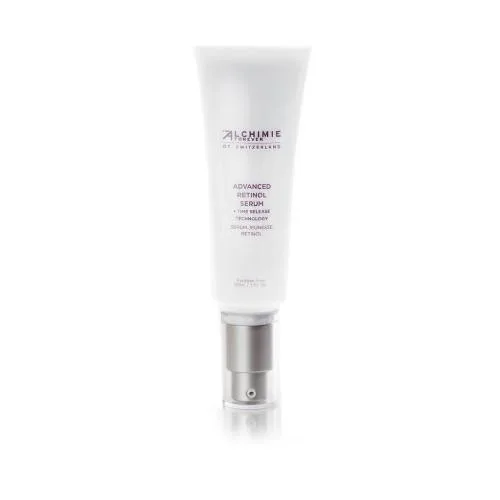
Alchimie Forever
Advanced Retinol Serum (2019 formulation)
uncategorized

Cleaner pick · Safest serums & essences we have rated
Africology Skincare & Spa
Aloe Ferox Serum+82 on ingredient safety
30ml · 569 ZAR · 1896.67 ZAR/100 ml
Ingredient safetyRaters agree
Ranked by safety only. Greenlens earns from qualifying purchases. Payout never affects a rating, a ranking, or the cleaner pick.
Raters split
Ingredient safety
A 85-point gap between the two loudest voices.
0Greenlens Ingredient ScanIndependent
vs85Health Canada Ingredient HotlistGovernment
050100
See why, ingredient by ingredientAll 3317 cleaner options, safest first We show the best 12, including the strongest on each axis.
Every rater, every axis
Ingredient safety
85 pts apartA government authority. Auto-linked to this product, not yet human-reviewed. Checked this week. about this rater →
Independent — not funded by the brands it rates. Auto-linked to this product, not yet human-reviewed. Checked this week. about this rater →
Independent — not funded by the brands it rates. Auto-linked to this product, not yet human-reviewed. Checked this week. about this rater →
A government authority. Auto-linked to this product, not yet human-reviewed. Checked this week. about this rater →
A government authority. Auto-linked to this product, not yet human-reviewed. Checked this week. about this rater →
Independent — not funded by the brands it rates. Auto-linked to this product, not yet human-reviewed. Checked this week. about this rater →
A government authority. Auto-linked to this product, not yet human-reviewed. Checked this week. about this rater →
Also screened, nothing found: ECHA SVHC Candidate List · US NTP Report on Carcinogens · IARC Monographs
Environmental
Also screened, nothing found: EU Microplastics Restriction
Labor
Run by a nonprofit. Auto-linked to this product, not yet human-reviewed. Checked this week. about this rater →
Coverage & match quality
8 ratings · 2 of 4 axes
- Some ratings rest on an automatic match that has not been human-reviewed.
- Fewer raters reach smaller-brand products, so a missing rating is not a clean bill of health, only a gap.
Weighted by what you care about
Tune your weights
composite recomputes live
+
1.0×
Environmentalno rating
No rater covers this axis for this product, so its weight can't move the score.
1.0×
Packagingno rating
No rater covers this axis for this product, so its weight can't move the score.
0 means ignored. Higher = more weight in your composite.
Ingredients, decoded
Data availability
Robust36 of 36 characterized
Our sources have reference data on all 36 listed ingredients.
Worth a look (13)
Reproductive-toxicant concernflagged by 5 of 9 lists →
Prop 65-listedflagged by 4 of 9 lists →
ANSES endocrine candidateflagged by 3 of 9 lists →
EU harmonised skin sensitizerflagged by 2 of 9 lists →
Undisclosed fragrance blendflagged by 2 of 9 lists →
EU harmonised skin sensitizerflagged by 2 of 9 lists →
ANSES endocrine candidateflagged by 2 of 9 lists →
EU harmonised skin sensitizerflagged by 2 of 9 lists →
ANSES endocrine candidateflagged by 2 of 9 lists →
EU-restricted (with limits)flagged by 2 of 9 lists →
EU-restricted (with limits)flagged by 2 of 9 lists →
EU-regulated fragrance allergenflagged by 1 of 9 lists →
EU-regulated fragrance allergenflagged by 1 of 9 lists →
No flags in our sources (23)
- Water/Aqua
- Caprylic/Capric Triglyceride
- Isononyl Isononanoate
- Glycerinhumectant
- Hydroxyethyl Acrylate/Sodium Acryloyldimethyl Taurate Copolymer
- Allyl Methacrylates Crosspolymer
- Squalane
- Simmondsia Chinensis Seed Oil
- Camellia Sinensis Leaf Extract
- Vaccinium Myrtillus Fruit Extract
- Leontopodium Alpinum Extract
- Trifolium Pratense Flower Extract
- Malus Domestica Fruit Cell Culture Extract
- Sodium Hyaluronatehumectant
- Ascorbyl Glucoside
- Tocopherol
- Polysorbate 20
- Polysorbate 60
- Isomalt
- Disodium EDTA
- Chlorphenesin
- Benzoic Acid
- Sorbic Acid
What these ingredient tags mean (4)
These describe what an ingredient is, not whether it is a problem. The stance marks above are the ratings; these are not.
fragrance materialBenzyl Alcohol, Geraniol, Hexyl Cinnamal, Alpha Isomethyl Ionone, Amyl Cinnamal, Linalool, Butylphenyl Methylpropional, Citronellol, Limonene
- Benzyl Alcohol: Used both as a fragrance component and as a preservative; the EU names it either way. EU Regulation (EC) 1223/2009, Annex III entry 45: a fragrance substance whose presence must be indicated in the list of ingredients above 0,001% in leave-on and 0,01% in rinse-off products, because of established contact-allergy risk. That entry carries transition footnote (38), which is footnote (37) plus a condition: stock that does not comply may still be made available until 31 July 2028 only "provided that they comply with the restrictions applicable on 15 August 2023", and only if it was lawfully placed on the Union market before the 31 July 2026 cut-off. Entry 45 covers its non-preservative use; it is separately an allowed preservative at Annex V entry 34.
- Geraniol: A rose-scented fragrance component named separately on the label. EU Regulation (EC) 1223/2009, Annex III entry 78: a fragrance substance whose presence must be indicated in the list of ingredients above 0,001% in leave-on and 0,01% in rinse-off products, because of established contact-allergy risk.
- Hexyl Cinnamal: A jasmine-like fragrance component named separately on the label. EU Regulation (EC) 1223/2009, Annex III entry 87: a fragrance substance whose presence must be indicated in the list of ingredients above 0,001% in leave-on and 0,01% in rinse-off products, because of established contact-allergy risk.
- Alpha Isomethyl Ionone: A powdery violet fragrance component named separately on the label. EU Regulation (EC) 1223/2009, Annex III entry 90: a fragrance substance whose presence must be indicated in the list of ingredients above 0,001% in leave-on and 0,01% in rinse-off products, because of established contact-allergy risk.
- Amyl Cinnamal: A jasmine-like fragrance component named separately on the label. EU Regulation (EC) 1223/2009, Annex III entry 67: a fragrance substance whose presence must be indicated in the list of ingredients above 0,001% in leave-on and 0,01% in rinse-off products, because of established contact-allergy risk.
- Linalool: A floral fragrance component named separately on the label. EU Regulation (EC) 1223/2009, Annex III entry 84: a fragrance substance whose presence must be indicated in the list of ingredients above 0,001% in leave-on and 0,01% in rinse-off products, because of established contact-allergy risk.
- Butylphenyl Methylpropional: A lily-of-the-valley fragrance component the EU no longer permits in cosmetics. It was a declarable fragrance allergen at Annex III entry 83 of EU Regulation (EC) 1223/2009. Commission Regulation (EU) 2021/1902 deleted that entry and moved it to Annex II entry 1666 (2-(4-tert-butylbenzyl) propionaldehyde, CAS 80-54-6), prohibiting it in cosmetic products from 1 March 2022.
- Citronellol: A rose-and-citrus fragrance component named separately on the label. EU Regulation (EC) 1223/2009, Annex III entry 86: a fragrance substance whose presence must be indicated in the list of ingredients above 0,001% in leave-on and 0,01% in rinse-off products, because of established contact-allergy risk.
- Limonene: A citrus-smelling fragrance component named separately on the label; the one name covers three related isomers. EU Regulation (EC) 1223/2009, Annex III entry 88: a fragrance substance whose presence must be indicated in the list of ingredients above 0,001% in leave-on and 0,01% in rinse-off products, because of established contact-allergy risk. That entry carries transition footnote (37): stock that does not comply, lawfully placed on the Union market before the 31 July 2026 cut-off, may still be made available until 31 July 2028. It is marked on the racemic dl-limonene/Dipentene line and the (S)-(l-limonene) line, but NOT the (R)-p-mentha-1,8-diene (d-limonene) line, CAS 5989-27-5, whose duty was already running as entry 88 before Commission Regulation (EU) 2023/1545 and so needed no transition. All three isomers are declared under the single glossary name "Limonene", so that name on a label does not identify which of them is present.
undeclared fragrance blendFragrance/Parfum
- Fragrance/Parfum: A blend the label does not itemize, so what is in it cannot be read from the ingredient list. EU Regulation (EC) 1223/2009 permits the collective term "parfum"; the SCCS Opinion on Fragrance Allergens (SCCS/1459/11) reviews the contact-allergy evidence for the substances it can contain.
retinoidRetinol
- Retinol: A vitamin A derivative that speeds skin turnover; dryness and flaking while skin adjusts are its usual accompaniment. SCCS Opinion on Vitamin A (Retinol, Retinyl Acetate, Retinyl Palmitate), SCCS/1576/16, final version of 6 October 2016; Commission Regulation (EU) 2024/996 added the group to EU Regulation (EC) 1223/2009 Annex III entry 376, capping it at 0,05% retinol equivalent in body lotion and 0,3% in other leave-on and rinse-off products, with the label statement "Contains Vitamin A. Consider your daily intake before use."
humectantGlycerin, Sodium Hyaluronate
- Glycerin: A humectant, and one of the two ingredients a comparison of moisturiser components found made a significant difference to skin hydration. FDA OTC skin protectant monograph, 21 CFR 347.10(h), lists glycerin as a skin protectant at 20 to 45%. On the humectant half: Jeong CB, Han JY, Cho JC, Suh KD, Nam GW, "Analysis of electrical property changes of skin by oil-in-water emulsion components", Int J Cosmet Sci 2013;35(4):402-410, DOI 10.1111/ics.12059, PMID 23621673, found that "glycerine and urea showed significant skin hydration effects compared with other humectants".
- Sodium Hyaluronate: A humectant that holds a large amount of water at the skin surface. Chylińska N, Maciejczyk M, "Hyaluronic Acid and Skin: Its Role in Aging and Wound-Healing Processes", Gels 2025;11(4):281, DOI 10.3390/gels11040281, PMID 40277717, open access: hyaluronic acid's "high osmotic activity and anionic structure enable it to bind large amounts of water", and "sodium and potassium hyaluronate are widely used in moisturizing products". The same review notes that high-molecular-weight hyaluronic acid does not penetrate the deeper layers.