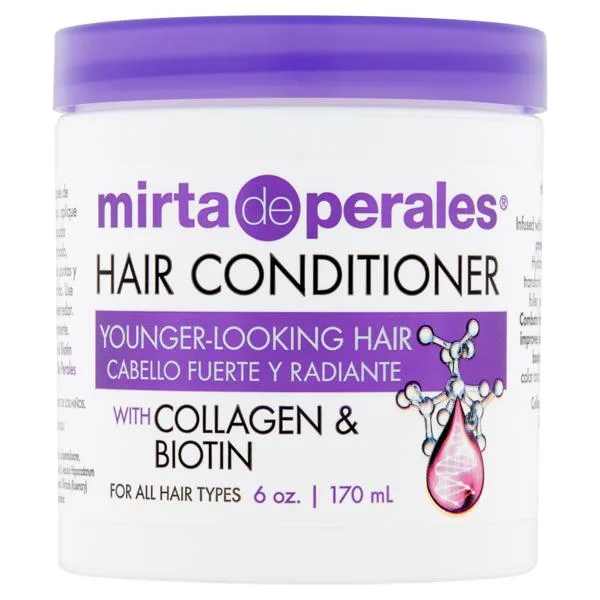
Mirta De Perales
Hair Conditioner With Collagen & Biotin
Conditioner6oz

Cleaner pick · Safest cleansing we have rated
Africology Skincare & Spa
Bio Therapy Shampoo+68 on ingredient safety
250ml · 47.50 ZAR · 19 ZAR/100 ml
Ingredient safetyRaters agree
Ranked by safety only. Greenlens earns from qualifying purchases. Payout never affects a rating, a ranking, or the cleaner pick.
Raters split
Ingredient safety
A 90-point gap between the two loudest voices.
0Greenlens Precautionary ScreenIndependent
vs90EU Harmonised Classification (CLP Annex VI)Government
050100
See why, ingredient by ingredientAll 10056 cleaner options, safest first We show the best 12, including the strongest on each axis.
Every rater, every axis
Ingredient safety
90 pts apartA government authority. Auto-linked to this product, not yet human-reviewed. Checked this week. about this rater →
Independent — not funded by the brands it rates. Auto-linked to this product, not yet human-reviewed. Checked this week. about this rater →
A government authority. Auto-linked to this product, not yet human-reviewed. Checked this week. about this rater →
Independent — not funded by the brands it rates. Auto-linked to this product, not yet human-reviewed. Checked this week. about this rater →
A government authority. Auto-linked to this product, not yet human-reviewed. Checked this week. about this rater →
A government authority. Auto-linked to this product, not yet human-reviewed. Checked this week. about this rater →
Independent — not funded by the brands it rates. Auto-linked to this product, not yet human-reviewed. Checked this week. about this rater →
A government authority. Auto-linked to this product, not yet human-reviewed. Checked this week. about this rater →
Also screened, nothing found: US NTP Report on Carcinogens · IARC Monographs
Environmental
Also screened, nothing found: EU Microplastics Restriction
Coverage & match quality
8 ratings · 1 of 4 axes
- Some ratings rest on an automatic match that has not been human-reviewed.
- Fewer raters reach smaller-brand products, so a missing rating is not a clean bill of health, only a gap.
Weighted by what you care about
Tune your weights
composite recomputes live
+
1.0×
Environmentalno rating
No rater covers this axis for this product, so its weight can't move the score.
Laborno rating
No rater covers this axis for this product, so its weight can't move the score.
Packagingno rating
No rater covers this axis for this product, so its weight can't move the score.
0 means ignored. Higher = more weight in your composite.
Ingredients, decoded
Data availability
Robust27 of 27 characterized
Our sources have reference data on all 27 listed ingredients.
Worth a look (9)
Carcinogen-linkedflagged by 5 of 9 lists →
Carcinogen-linkedflagged by 1 of 9 lists →
Strong contact sensitizerflagged by 3 of 9 lists →
Undisclosed fragrance blendflagged by 2 of 9 lists →
ANSES endocrine candidateflagged by 1 of 9 lists →
Strong contact sensitizerflagged by 2 of 9 lists →
EU-restricted (with limits)flagged by 2 of 9 lists →
Persistent / bioaccumulativeflagged by 1 of 9 lists →
EU-restricted (with limits)flagged by 2 of 9 lists →
No flags in our sources (18)
- WATER
- GLYCERINhumectant
- CETYL ALCOHOL
- STEARYL ALCOHOL
- BEHENTRIMONIUM METHOSULFATE
- HYDROXYETHYLCELLULOSE
- BUTYLENE GLYCOL
- PEG-35 CASTOR OIL
- POLYSORBATE 20
- AESCULUS HIPPOCASTANUM SEED EXTRACT
- TOCOPHEROL
- INOSITOL
- CALCIUM PANTOTHENATE
- LINOLEIC ACIDbarrier lipid
- BIOTIN
- ROSMARINUS OFFICINALIS LEAF OILfragrance material
- HYDROLYZED COLLAGEN
- DISODIUM EDTA
What these ingredient tags mean (6)
These describe what an ingredient is, not whether it is a problem. The stance marks above are the ratings; these are not.
commonly dryingALCOHOL
- ALCOHOL: A fast-evaporating solvent that leaves a dry finish. International Chemical Safety Card ICSC 0044, Ethanol (anhydrous), prepared by an international group of experts for the ILO and WHO: "The substance defats the skin, which may cause dryness or cracking." Bommannan et al., as reported by Lachenmeier DW, "Safety evaluation of topical applications of ethanol on the skin and inside the oral cavity", J Occup Med Toxicol 2008;3:26, DOI 10.1186/1745-6673-3-26, open access, reference 82: "Bommannan et al. found in vivo in humans that ethanol enters the skin and removes measurable quantities of the lipid barrier material from the stratum corneum." Both describe stronger exposures than a cosmetic formula.
common irritantDMDM HYDANTOIN, METHYLCHLOROISOTHIAZOLINONE, METHYLISOTHIAZOLINONE
- DMDM HYDANTOIN: A preservative the FDA lists as a formaldehyde releaser, which is why formaldehyde-reactive skin can notice it. How much reaches the skin depends on the whole formula, not on this name alone. EU Regulation (EC) 1223/2009, Annex V entry 33, permits DMDM hydantoin as a preservative up to 0,6%. The FDA names it among the "formaldehyde and formaldehyde releasing ingredients" on its Allergens in Cosmetics page (content current 25 February 2022). SCCS Scientific Advice SCCS/1632/21, on the threshold for the "contains formaldehyde" warning, describes a study in which a moisturiser spiked to the 0,6% Annex V maximum released at least 40 ppm formaldehyde. Annex V preamble point 2, as amended by Commission Regulation (EU) 2022/1181, requires the warning "releases formaldehyde" on any product whose total released formaldehyde exceeds 0,001% (10 ppm). That Regulation states the sensitisation ground itself, so the chain is drawn by the regulator and not by us: recital (2) names the class, "Certain of those preservatives are gradually releasing formaldehyde in order to fulfil a preserving function in the final cosmetic product (so called formaldehyde releasers)", and recital (3) gives the purpose of the warning, "In order to inform consumers sensitised to formaldehyde about the presence of formaldehyde that may trigger an allergic reaction". Recital (1) records that formaldehyde is classified a skin sensitizer (Category 1) in Part 3 of Annex VI to Regulation (EC) 1272/2008.
- METHYLCHLOROISOTHIAZOLINONE: A preservative restricted to rinse-off products in the EU because of contact-allergy reports. EU Regulation (EC) 1223/2009, Annex V entry 39 (rinse-off only, 0,0015% of a 3:1 mixture with methylisothiazolinone). The reason is in Commission Regulation (EU) No 1003/2014, recital 3, quoted rather than summarised: "The SCCS concluded that the mixture of Methylchloroisothiazolinone (and) Methylisothiazolinone in a ratio of 3:1 does not pose a risk to the health of the consumer when used as a preservative up to a maximum authorised concentration of 0,0015 % in rinse-off cosmetic products, apart from its skin sensitising potential. The SCCS indicated that induction and elicitation would be less likely in a rinse-off product than when the same concentration is present in a leave-on product." SCCS/1238/09 concludes it "is well recognised as an important skin sensitiser at current conditions of use".
- METHYLISOTHIAZOLINONE: A preservative that patch-test clinics see reactions to often enough that the EU banned it from leave-on products. American Contact Dermatitis Society, Allergen of the Year 2013 (Castanedo-Tardana MP, Zug KA, Dermatitis 2013;24(1):2-6); SCCS Opinion on Methylisothiazolinone (P94), Submission II, SENSITISATION ONLY (SCCS/1521/13, revision of 27 March 2014); banned in leave-on cosmetics by Commission Regulation (EU) 2016/1198, which recites the need to address "the increased incidence of allergies induced by methylisothiazolinone".
undeclared fragrance blendFRAGRANCE
- FRAGRANCE: A blend the label does not itemize, so what is in it cannot be read from the ingredient list. EU Regulation (EC) 1223/2009 permits the collective term "parfum"; the SCCS Opinion on Fragrance Allergens (SCCS/1459/11) reviews the contact-allergy evidence for the substances it can contain.
retinoidRETINYL PALMITATE
- RETINYL PALMITATE: A gentler vitamin A ester that the skin converts to retinol. SCCS Opinion on Vitamin A (Retinol, Retinyl Acetate, Retinyl Palmitate), SCCS/1576/16, which assesses retinyl palmitate by name; EU Regulation (EC) 1223/2009 Annex III entry 376 covers it in the same group as retinol.
humectantGLYCERIN
- GLYCERIN: A humectant, and one of the two ingredients a comparison of moisturiser components found made a significant difference to skin hydration. FDA OTC skin protectant monograph, 21 CFR 347.10(h), lists glycerin as a skin protectant at 20 to 45%. On the humectant half: Jeong CB, Han JY, Cho JC, Suh KD, Nam GW, "Analysis of electrical property changes of skin by oil-in-water emulsion components", Int J Cosmet Sci 2013;35(4):402-410, DOI 10.1111/ics.12059, PMID 23621673, found that "glycerine and urea showed significant skin hydration effects compared with other humectants".
barrier lipidLINOLEIC ACID
- LINOLEIC ACID: An essential fatty acid the skin barrier uses and cannot make for itself. Khnykin D, Miner JH, Jahnsen F, "Role of fatty acid transporters in epidermis", Dermatoendocrinol 2011;3(2):53-61, DOI 10.4161/derm.3.2.14816, open access: "The human body can produce all but two of the fatty acids it needs: linoleic acid (C18:2, n6) and alpha-linolenic acid (C18:3, n3)", and replacing linoleic acid with a non-essential fatty acid "will lead to barrier defects". Feingold and Elias, J Lipid Res 2024: linoleate "is required for the synthesis of a subgroup of acylceramides".