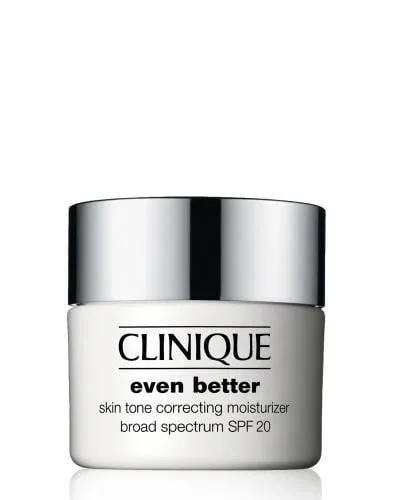
Clinique
Even Better Skin Tone Correcting Moisturizer SPF 20
Sun Care

Cleaner pick · Safest sunscreen we have rated
Iunik Global
Centella Calming Daily Sunscreen+32 on ingredient safety
$24
Ingredient safetyRaters agree
Ranked by safety only. Greenlens earns from qualifying purchases. Payout never affects a rating, a ranking, or the cleaner pick.
Raters split
Ingredient safety
A 25-point gap between the two loudest voices.
60Greenlens Precautionary ScreenIndependent
vs85Health Canada Ingredient HotlistGovernment
050100
See why, ingredient by ingredientAll 1208 cleaner options, safest first We show the best 12, including the strongest on each axis.
Every rater, every axis
Ingredient safety
25 pts apartIndependent — not funded by the brands it rates. Auto-linked to this product, not yet human-reviewed. Checked this week. about this rater →
Independent — not funded by the brands it rates. Auto-linked to this product, not yet human-reviewed. Checked this week. about this rater →
Independent — not funded by the brands it rates. Auto-linked to this product, not yet human-reviewed. Checked this week. about this rater →
A government authority. Auto-linked to this product, not yet human-reviewed. Checked this week. about this rater →
A government authority. Auto-linked to this product, not yet human-reviewed. Checked this week. about this rater →
A government authority. Auto-linked to this product, not yet human-reviewed. Checked this week. about this rater →
Also screened, nothing found: California Proposition 65 · US NTP Report on Carcinogens · IARC Monographs · ECHA SVHC Candidate List
Environmental
A government authority. Auto-linked to this product, not yet human-reviewed. Checked this week. about this rater →
Labor
Run by a nonprofit. Auto-linked to this product, not yet human-reviewed. This rates Clinique as a company and applies to everything they make, not this product alone. Checked this week. about this rater →
Coverage & match quality
8 ratings · 3 of 4 axes
- Some ratings rest on an automatic match that has not been human-reviewed.
- Fewer raters reach smaller-brand products, so a missing rating is not a clean bill of health, only a gap.
Weighted by what you care about
Tune your weights
composite recomputes live
+
1.0×
1.0×
1.0×
Packagingno rating
No rater covers this axis for this product, so its weight can't move the score.
0 means ignored. Higher = more weight in your composite.
Ingredients, decoded
Data availability
Robust60 of 61 characterized
Our sources have reference data on 60 of 61 listed ingredients; 1 is uncharacterized in our data — a gap, not a clean bill.
Worth a look (8)
Strong contact sensitizerflagged by 1 of 9 lists →
ANSES endocrine candidateflagged by 1 of 9 lists →
EU harmonised CMR (cat. 2)flagged by 4 of 9 lists →
EU microplastics-restrictedflagged by 1 of 9 lists →
EU microplastics-restrictedflagged by 1 of 9 lists →
EU-restricted (with limits)flagged by 2 of 9 lists →
EU-restricted (with limits)flagged by 2 of 9 lists →
Mild sensitizer for someflagged by 1 of 9 lists →
No flags in our sources (52)
- Octisalate
- Avobenzone
- Water/Aqua/Eau
- Butyloctyl Salicylate
- Octyldodecyl Neopentanoate
- Behenyl Alcohol
- Myristyl Myristatecomedogenic in testing
- Saccharomyces Cerevisiae Extract
- Ascorbyl Glucoside
- Cetyl Esters
- Butylene Glycol
- Ammonium Acryloyldimethyltaurate/Vp Copolymer
- Yeast Extract/Faex/Extrait De Levure
- Betula Alba Bark Extract
- Cucumis Sativus Fruit Extract
- Scutellaria Baicalensis Root Extract
- Pyrus Malus Fruit Extract
- Trametes Versicolor Extract
- Saccharomyces Lysate Extract
- Punica Granatum Juice Extract
- Olea Europaea Fruit Extract
- Curcuma Longa Root Extract
- Oryza Sativa Bran Extract
- Citrus Grandis Peel Extract
- Peg-6
- Cholesterolbarrier lipid
- Dimethiconerich occlusive
- Glyceryl Stearate
- Peg-100 Stearate
- Glycerinhumectant
- Di-Ppg-2 Myreth-10 Adipate
- Steareth-21
- Sodium Rna
- Cellulose
- Acetyl Glucosamine
- Simethicone
- Tromethaminefragrance material
- Sucrose
- Di-C12-18 Alkyl Dimonium Chloride
- Sodium Hyaluronatehumectant
- Tocopheryl Acetate
- Trisiloxane
- Linoleic Acidbarrier lipid
- Caprylyl Glycol
- Magnesium Ascorbyl Phosphate
- Betaine
- Trehalose
- Hexylene Glycol
- Dipotassium Glycyrrhizate
- Lauryl Peg-9 Polydimethylsiloxyethyl Dimethicone
- Disodium Edta
- Polyaminopropyl Biguanide
No data in our sources (1)
Not a verdict — our authorities simply have no reference for these.
What these ingredient tags mean (5)
These describe what an ingredient is, not whether it is a problem. The stance marks above are the ratings; these are not.
comedogenic in testingMyristyl Myristate
- Myristyl Myristate: A waxy emollient named among the pore-clogging materials in the rabbit-ear assay. Fulton JE Jr, Pay SR, Fulton JE 3rd, "Comedogenicity of current therapeutic products, cosmetics, and ingredients in the rabbit ear", J Am Acad Dermatol 1984;10(1):96-105, PMID 6229554. The openly readable abstract names this ingredient among its "ingredient offenders", in prose and without a numeric rating: "Ingredient offenders include isopropyl myristate and its analogs, such as isopropyl palmitate, isopropyl isostearate, butyl stearate, isostearyl neopentanoate, myristyl myristate..." The rabbit-ear assay rates raw ingredients and does not predict how a finished formula behaves on human skin.
exfoliating acidSalicylic Acid
- Salicylic Acid: A beta hydroxy acid that clears the inside of pores; the EU restricts its level and keeps it off children under three. SCCS Opinion on Salicylic Acid, Submission I (SCCS/1601/18, corrigendum of 20 to 21 June 2019); EU Regulation (EC) 1223/2009 Annex III entry 98, as amended by Commission Regulation (EU) 2021/850, which for purposes other than preservation caps it at 3,0% in rinse-off hair products, 2,0% in other products, and 0,5% in body lotion, eye shadow, mascara, eyeliner, lipstick and roll-on deodorant, and states "Not to be used in preparations for children under 3 years of age." Its separate PRESERVATIVE use sits at Annex V entry 3, capped at 0,5% (acid), where the salts carry the carve-out "except for shampoos".
rich occlusiveDimethicone
- Dimethicone: A silicone that forms a film on the surface of the skin without an oily feel. FDA OTC skin protectant monograph, 21 CFR 347.10(g), lists dimethicone as a skin protectant at 1 to 30%.
humectantGlycerin, Sodium Hyaluronate
- Glycerin: A humectant, and one of the two ingredients a comparison of moisturiser components found made a significant difference to skin hydration. FDA OTC skin protectant monograph, 21 CFR 347.10(h), lists glycerin as a skin protectant at 20 to 45%. On the humectant half: Jeong CB, Han JY, Cho JC, Suh KD, Nam GW, "Analysis of electrical property changes of skin by oil-in-water emulsion components", Int J Cosmet Sci 2013;35(4):402-410, DOI 10.1111/ics.12059, PMID 23621673, found that "glycerine and urea showed significant skin hydration effects compared with other humectants".
- Sodium Hyaluronate: A humectant that holds a large amount of water at the skin surface. Chylińska N, Maciejczyk M, "Hyaluronic Acid and Skin: Its Role in Aging and Wound-Healing Processes", Gels 2025;11(4):281, DOI 10.3390/gels11040281, PMID 40277717, open access: hyaluronic acid's "high osmotic activity and anionic structure enable it to bind large amounts of water", and "sodium and potassium hyaluronate are widely used in moisturizing products". The same review notes that high-molecular-weight hyaluronic acid does not penetrate the deeper layers.
barrier lipidCholesterol, Linoleic Acid
- Cholesterol: One of the three lipid classes that make up the skin barrier, alongside ceramides and fatty acids. Feingold KR and Elias PM, J Lipid Res 2024, open access: the barrier lipid matrix "by weight is approximately 50% ceramides, 25% cholesterol, and 15% free fatty acids". Corroborated by Wertz PW, "Roles of Lipids in the Permeability Barriers of Skin and Oral Mucosa", Int J Mol Sci 2021;22(10):5229, DOI 10.3390/ijms22105229, PMID 34063352.
- Linoleic Acid: An essential fatty acid the skin barrier uses and cannot make for itself. Khnykin D, Miner JH, Jahnsen F, "Role of fatty acid transporters in epidermis", Dermatoendocrinol 2011;3(2):53-61, DOI 10.4161/derm.3.2.14816, open access: "The human body can produce all but two of the fatty acids it needs: linoleic acid (C18:2, n6) and alpha-linolenic acid (C18:3, n3)", and replacing linoleic acid with a non-essential fatty acid "will lead to barrier defects". Feingold and Elias, J Lipid Res 2024: linoleate "is required for the synthesis of a subgroup of acylceramides".
Where this came from
Cruelty-free status recorded from crueltyfreekitty.com ↗
Researched facts on Greenlens always carry the page that stated them — nothing is inferred from a model's memory.