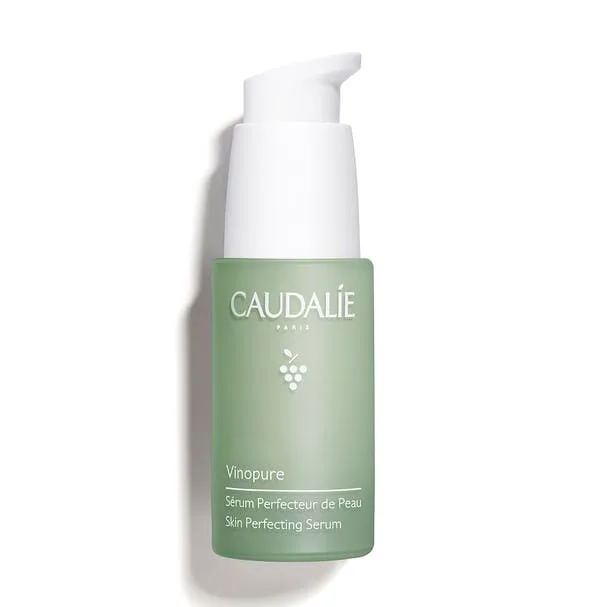
Caudalie
Vinopure Natural Salicylic Acid Pore Minimizing Serum
uncategorized

Cleaner pick · Safest serums & essences we have rated
Africology Skincare & Spa
Aloe Ferox Serum+57 on ingredient safety
30ml · 569 ZAR · 1896.67 ZAR/100 ml
Ingredient safetyRaters agree
Ranked by safety only. Greenlens earns from qualifying purchases. Payout never affects a rating, a ranking, or the cleaner pick.
Raters split
Ingredient safety
A 80-point gap between the two loudest voices.
20ANSES Endocrine DisruptorsGovernment
vs100Greenlens Precautionary ScreenIndependent
050100
See why, ingredient by ingredientAll 2170 cleaner options, safest first We show the best 12, including the strongest on each axis.
Every rater, every axis
Ingredient safety
80 pts apartA government authority. Auto-linked to this product, not yet human-reviewed. Checked this week. about this rater →
Independent — not funded by the brands it rates. Auto-linked to this product, not yet human-reviewed. Checked this week. about this rater →
A government authority. Auto-linked to this product, not yet human-reviewed. Checked this week. about this rater →
Independent — not funded by the brands it rates. Auto-linked to this product, not yet human-reviewed. Checked this week. about this rater →
Independent — not funded by the brands it rates. Auto-linked to this product, not yet human-reviewed. Checked this week. about this rater →
A government authority. Auto-linked to this product, not yet human-reviewed. Checked this week. about this rater →
Also screened, nothing found: California Proposition 65 · IARC Monographs · US NTP Report on Carcinogens · ECHA SVHC Candidate List
Environmental
Also screened, nothing found: EU Microplastics Restriction
Labor
Run by a nonprofit. Auto-linked to this product, not yet human-reviewed. This rates Caudalie as a company and applies to everything they make, not this product alone. Checked this week. about this rater →
Coverage & match quality
7 ratings · 2 of 4 axes
- Some ratings rest on an automatic match that has not been human-reviewed.
- Fewer raters reach smaller-brand products, so a missing rating is not a clean bill of health, only a gap.
Weighted by what you care about
Tune your weights
composite recomputes live
+
1.0×
Environmentalno rating
No rater covers this axis for this product, so its weight can't move the score.
1.0×
Packagingno rating
No rater covers this axis for this product, so its weight can't move the score.
0 means ignored. Higher = more weight in your composite.
Ingredients, decoded
Data availability
Robust23 of 23 characterized
Our sources have reference data on all 23 listed ingredients.
Worth a look (12)
ANSES endocrine candidateflagged by 3 of 9 lists
ANSES endocrine candidateflagged by 3 of 9 lists
ANSES endocrine candidateflagged by 1 of 9 lists
EU harmonised CMR (cat. 2)flagged by 4 of 9 lists
ANSES endocrine candidateflagged by 2 of 9 lists
EU harmonised skin sensitizerflagged by 2 of 9 lists
EU harmonised skin sensitizerflagged by 2 of 9 lists
EU-regulated fragrance allergenflagged by 1 of 9 lists
EU-regulated fragrance allergenflagged by 1 of 9 lists
EU-restricted (with limits)flagged by 2 of 9 lists
EU-regulated fragrance allergenflagged by 1 of 9 lists
EU-regulated fragrance allergenflagged by 1 of 9 lists
No flags in our sources (11)
What these ingredient tags mean (5)
These describe what an ingredient is, not whether it is a problem. The stance marks above are the ratings; these are not.
commonly dryingalcohol
- alcohol: A fast-evaporating solvent that leaves a dry finish. International Chemical Safety Card ICSC 0044, Ethanol (anhydrous), prepared by an international group of experts for the ILO and WHO: "The substance defats the skin, which may cause dryness or cracking." Bommannan et al., as reported by Lachenmeier DW, "Safety evaluation of topical applications of ethanol on the skin and inside the oral cavity", J Occup Med Toxicol 2008;3:26, DOI 10.1186/1745-6673-3-26, open access, reference 82: "Bommannan et al. found in vivo in humans that ethanol enters the skin and removes measurable quantities of the lipid barrier material from the stratum corneum." Both describe stronger exposures than a cosmetic formula.
fragrance materialmentha piperita oil, citral, citronellol, geraniol, linalool, limonene
- mentha piperita oil: A cooling essential oil the EU names on its own account as a fragrance substance to be declared on the label. EU Regulation (EC) 1223/2009, Annex III entry 361, inserted by Commission Regulation (EU) 2023/1545: a fragrance substance whose presence must be indicated in the list of ingredients above 0,001% in leave-on and 0,01% in rinse-off products. It is declarable in its OWN right, not by way of any component it carries. The name to look for on a label is "Mentha Piperita Oil". The duty applies now. Transition footnote (40) lets stock that does not comply, lawfully placed on the Union market before the 31 July 2026 cut-off, be made available until 31 July 2028.
- citral: A lemon-scented fragrance component named separately on the label; the one name covers three related substances. EU Regulation (EC) 1223/2009, Annex III entry 70: a fragrance substance whose presence must be indicated in the list of ingredients above 0,001% in leave-on and 0,01% in rinse-off products, because of established contact-allergy risk. As replaced by Commission Regulation (EU) 2026/909 of 27 April 2026, the entry is a GROUPED one covering citral, geranial and neral, declared collectively as "Citral", with per-product-type caps from 0,032% in deodorant to 1,2% in rinse-off and leave-on hair products. Its three substances carry two different sell-through dates: products not complying may not be placed on the Union market from 1 January 2027 in every case, and may not be made available from 1 July 2028 for citral, footnote (**), or from 1 August 2028 for geranial and neral, footnote (***). In the consolidated text those two footnotes are renumbered (46) and (47); both are worded "these substances", where the footnotes that attach to a single named substance say "that substance".
- citronellol: A rose-and-citrus fragrance component named separately on the label. EU Regulation (EC) 1223/2009, Annex III entry 86: a fragrance substance whose presence must be indicated in the list of ingredients above 0,001% in leave-on and 0,01% in rinse-off products, because of established contact-allergy risk.
- geraniol: A rose-scented fragrance component named separately on the label. EU Regulation (EC) 1223/2009, Annex III entry 78: a fragrance substance whose presence must be indicated in the list of ingredients above 0,001% in leave-on and 0,01% in rinse-off products, because of established contact-allergy risk.
- linalool: A floral fragrance component named separately on the label. EU Regulation (EC) 1223/2009, Annex III entry 84: a fragrance substance whose presence must be indicated in the list of ingredients above 0,001% in leave-on and 0,01% in rinse-off products, because of established contact-allergy risk.
- limonene: A citrus-smelling fragrance component named separately on the label; the one name covers three related isomers. EU Regulation (EC) 1223/2009, Annex III entry 88: a fragrance substance whose presence must be indicated in the list of ingredients above 0,001% in leave-on and 0,01% in rinse-off products, because of established contact-allergy risk. That entry carries transition footnote (37): stock that does not comply, lawfully placed on the Union market before the 31 July 2026 cut-off, may still be made available until 31 July 2028. It is marked on the racemic dl-limonene/Dipentene line and the (S)-(l-limonene) line, but NOT the (R)-p-mentha-1,8-diene (d-limonene) line, CAS 5989-27-5, whose duty was already running as entry 88 before Commission Regulation (EU) 2023/1545 and so needed no transition. All three isomers are declared under the single glossary name "Limonene", so that name on a label does not identify which of them is present.
exfoliating acidsalicylic acid
- salicylic acid: A beta hydroxy acid that clears the inside of pores; the EU restricts its level and keeps it off children under three. SCCS Opinion on Salicylic Acid, Submission I (SCCS/1601/18, corrigendum of 20 to 21 June 2019); EU Regulation (EC) 1223/2009 Annex III entry 98, as amended by Commission Regulation (EU) 2021/850, which for purposes other than preservation caps it at 3,0% in rinse-off hair products, 2,0% in other products, and 0,5% in body lotion, eye shadow, mascara, eyeliner, lipstick and roll-on deodorant, and states "Not to be used in preparations for children under 3 years of age." Its separate PRESERVATIVE use sits at Annex V entry 3, capped at 0,5% (acid), where the salts carry the carve-out "except for shampoos".
humectantsodium hyaluronate
- sodium hyaluronate: A humectant that holds a large amount of water at the skin surface. Chylińska N, Maciejczyk M, "Hyaluronic Acid and Skin: Its Role in Aging and Wound-Healing Processes", Gels 2025;11(4):281, DOI 10.3390/gels11040281, PMID 40277717, open access: hyaluronic acid's "high osmotic activity and anionic structure enable it to bind large amounts of water", and "sodium and potassium hyaluronate are widely used in moisturizing products". The same review notes that high-molecular-weight hyaluronic acid does not penetrate the deeper layers.
soothingniacinamide
- niacinamide: A vitamin B3 form that supports the skin barrier and has anti-inflammatory activity; it turns up in products aimed at acne, rosacea and eczema. Camillo L, Zavattaro E, Savoia P, "Nicotinamide: A Multifaceted Molecule in Skin Health and Beyond", Medicina (Kaunas) 2025;61(2):254, DOI 10.3390/medicina61020254, PMID 40005371, open access: it "is extensively used in ... the treatment of dermatological conditions such as blistering diseases, atopic dermatitis, rosacea, and acne vulgaris", and contributes to reducing inflammation. On the acne evidence specifically: Liu H, Yu H, Xia J, Liu L, Liu GJ, Sang H, Peinemann F, "Topical azelaic acid, salicylic acid, nicotinamide, sulphur, zinc and fruit acid (alpha-hydroxy acid) for acne", Cochrane Database Syst Rev 2020;5:CD011368, DOI 10.1002/14651858.CD011368.pub2, PMID 32356369, records "low-quality evidence" for every nicotinamide comparison it could pool, and none of its four nicotinamide studies measured the physician global assessment at all.