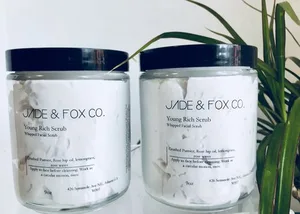
Jade & Fox Co.
Scrub, Young Rich (2020 formulation)
uncategorized
Every rater, every axis
Ingredient safety
Environmental
Also screened, nothing found: EU Microplastics Restriction
Weighted by what you care about
Tune your weights
composite recomputes live
+
Ingredient safetyno rating
No rater covers this axis for this product, so its weight can't move the score.
Environmentalno rating
No rater covers this axis for this product, so its weight can't move the score.
Laborno rating
No rater covers this axis for this product, so its weight can't move the score.
Packagingno rating
No rater covers this axis for this product, so its weight can't move the score.
0 means ignored. Higher = more weight in your composite.
Ingredients, decoded
Data availability
Not enough to score9 of 15 characterized
Our sources have reference data on 9 of 15 listed ingredients; 6 are uncharacterized in our data — a gap, not a clean bill. That is not enough of the label for a safety score to be honest, so we do not publish one.
No flags in our sources (9)
No data in our sources (6)
- Aloe Barbadensis * Aspalathus Linearis Glycerin
- Disodium Rose hip
- rose water
- l
- Lauryl Sulfosuccinate
- Iodopropynyl Butylcarbamat
Not a verdict — our authorities simply have no reference for these.
What these ingredient tags mean (1)
These describe what an ingredient is, not whether it is a problem. The stance marks above are the ratings; these are not.
common irritantPropylene Glycol, Diazolidinyl Urea
- Propylene Glycol: A solvent that shows up in patch-test clinics, more often as irritation than as allergy. American Contact Dermatitis Society, Allergen of the Year 2018 (Jacob SE, Scheman A, McGowan MA, Dermatitis 2018;29(1):3-5).
- Diazolidinyl Urea: A preservative the FDA lists as a formaldehyde releaser, so formaldehyde-reactive skin can notice it. How much reaches the skin depends on the whole formula, not on this name alone. EU Regulation (EC) 1223/2009, Annex V entry 46, permits diazolidinyl urea as a preservative up to 0,5%. The FDA names it among the "formaldehyde and formaldehyde releasing ingredients" on its Allergens in Cosmetics page (content current 25 February 2022). Annex V preamble point 2, as amended by Commission Regulation (EU) 2022/1181, requires the warning "releases formaldehyde" on any product whose total released formaldehyde exceeds 0,001% (10 ppm). That Regulation states the sensitisation ground itself, so the chain is drawn by the regulator and not by us: recital (2) names the class, "Certain of those preservatives are gradually releasing formaldehyde in order to fulfil a preserving function in the final cosmetic product (so called formaldehyde releasers)", and recital (3) gives the purpose of the warning, "In order to inform consumers sensitised to formaldehyde about the presence of formaldehyde that may trigger an allergic reaction". Recital (1) records that formaldehyde is classified a skin sensitizer (Category 1) in Part 3 of Annex VI to Regulation (EC) 1272/2008.