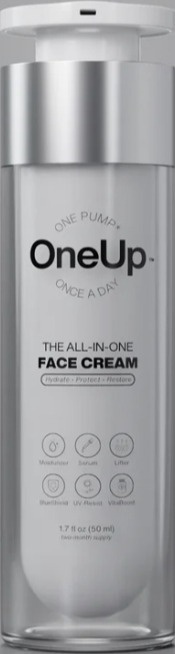
OneUp
All-in-one Face Cream
Face Moisturizer1.7ozGTIN 0755439031827

Cleaner pick · Safest multi-function moisturizers we have rated
DHC
Astaxanthin Collagen All-in-One Gel+39 on ingredient safety
$53
Ingredient safetyRaters agree
Ranked by safety only. Greenlens earns from qualifying purchases. Payout never affects a rating, a ranking, or the cleaner pick.
Raters split
Ingredient safety
A 44-point gap between the two loudest voices.
50EU Harmonised Classification (CLP Annex VI)Government
vs94Greenlens Tolerance ScreenIndependent
050100
See why, ingredient by ingredientAll 29 cleaner options, safest first We show the best 12, including the strongest on each axis.
Every rater, every axis
Ingredient safety
44 pts apartA government authority. Auto-linked to this product, not yet human-reviewed. Checked this week. about this rater →
Independent — not funded by the brands it rates. Auto-linked to this product, not yet human-reviewed. Checked this week. about this rater →
Independent — not funded by the brands it rates. Auto-linked to this product, not yet human-reviewed. Checked this week. about this rater →
A government authority. Auto-linked to this product, not yet human-reviewed. Checked this week. about this rater →
Independent — not funded by the brands it rates. Auto-linked to this product, not yet human-reviewed. Checked this week. about this rater →
A government authority. Auto-linked to this product, not yet human-reviewed. Checked this week. about this rater →
Also screened, nothing found: ECHA SVHC Candidate List · US NTP Report on Carcinogens · California Proposition 65 · IARC Monographs
Environmental
raters agreeRun by a nonprofit. Auto-linked to this product, not yet human-reviewed. Checked this week. about this rater →
A government authority. Auto-linked to this product, not yet human-reviewed. Checked this week. about this rater →
Packaging
Independent — not funded by the brands it rates. Auto-linked to this product, not yet human-reviewed. Checked this week. about this rater →
Coverage & match quality
9 ratings · 3 of 4 axes
- Some ratings rest on an automatic match that has not been human-reviewed.
- Fewer raters reach smaller-brand products, so a missing rating is not a clean bill of health, only a gap.
Weighted by what you care about
Tune your weights
composite recomputes live
+
1.0×
1.0×
Laborno rating
No rater covers this axis for this product, so its weight can't move the score.
1.0×
0 means ignored. Higher = more weight in your composite.
Ingredients, decoded
Data availability
Robust37 of 43 characterized
Our sources have reference data on 37 of 43 listed ingredients; 6 are uncharacterized in our data — a gap, not a clean bill.
Worth a look (7)
ANSES endocrine candidateflagged by 3 of 9 lists →
EU harmonised skin sensitizerflagged by 2 of 9 lists →
EU harmonised CMR (cat. 2)flagged by 4 of 9 lists →
ANSES endocrine candidateflagged by 2 of 9 lists →
EU harmonised skin sensitizerflagged by 2 of 9 lists →
Persistent / bioaccumulativeflagged by 2 of 9 lists →
Mild sensitizer for someflagged by 1 of 9 lists →
No flags in our sources (30)
- Water
- Shea Butter Ethyl Esters
- Oleyl Oleate
- Glyceryl Stearate
- Niacinamidesoothing
- Polyglyceryl-6 Palmitate/Succinate
- Fructooligosaccharides
- Propylene Glycolcommon irritant
- Theobroma Cacao Seed Butterrich occlusive
- Sodium Ascorbyl Phosphate
- Methyl Diisopropyl Propionamidefragrance material
- Menthyl Lactatefragrance material
- Ethyl Menthane Carboxamide
- Hydroxypropyl Cellulose
- Isopropyl Palmitatecomedogenic in testing
- Ethylhexylglycerin
- Sodium Hyaluronatehumectant
- Glycerinhumectant
- Xanthan Gum
- Acetyl Hexapeptide-8
- Potassium Sorbate
- Cetearyl Alcohol
- Sodium Polyacrylate
- Lecithin
- Sclerotium Gum
- Pullulan
- Lavender Oilfragrance material
- Argania Spinosa Kernel Oil
- Sorbic Acid
- Zinc Oxidesoothing
No data in our sources (6)
- Caprylic Triglyceride
- Beet Root Extract
- Edelweiss Culture Extract
- Borage Oil
- Brazil Nut Oil
- Clove Bud Oil
Not a verdict — our authorities simply have no reference for these.
What these ingredient tags mean (7)
These describe what an ingredient is, not whether it is a problem. The stance marks above are the ratings; these are not.
comedogenic in testingIsopropyl Palmitate
- Isopropyl Palmitate: A light emollient named among the pore-clogging materials in the rabbit-ear assay. Fulton JE Jr, Pay SR, Fulton JE 3rd, "Comedogenicity of current therapeutic products, cosmetics, and ingredients in the rabbit ear", J Am Acad Dermatol 1984;10(1):96-105, PMID 6229554. The openly readable abstract names this ingredient among its "ingredient offenders", in prose and without a numeric rating: "Ingredient offenders include isopropyl myristate and its analogs, such as isopropyl palmitate, isopropyl isostearate, butyl stearate, isostearyl neopentanoate, myristyl myristate..." The rabbit-ear assay rates raw ingredients and does not predict how a finished formula behaves on human skin.
common irritantPropylene Glycol
- Propylene Glycol: A solvent that shows up in patch-test clinics, more often as irritation than as allergy. American Contact Dermatitis Society, Allergen of the Year 2018 (Jacob SE, Scheman A, McGowan MA, Dermatitis 2018;29(1):3-5).
fragrance materialLavender Oil, Benzyl Alcohol, Eugenol, Linalool, Limonene
- Lavender Oil: An essential oil the EU names on its own account as a fragrance substance to be declared on the label, under a shared name covering several lavender species. EU Regulation (EC) 1223/2009, Annex III entry 360, inserted by Commission Regulation (EU) 2023/1545: a fragrance substance whose presence must be indicated in the list of ingredients above 0,001% in leave-on and 0,01% in rinse-off products. It is declarable in its OWN right, not by way of any component it carries. The entry is a GROUPED one covering the oils and extracts of Lavandula angustifolia, Lavandula intermedia and Lavandula hybrida, about eight glossary names in all, all declared under the single common name "Lavandula Oil/ Extract", so that name on a label does not identify which of them is present. The duty applies now. Transition footnote (40) lets stock that does not comply, lawfully placed on the Union market before the 31 July 2026 cut-off, be made available until 31 July 2028.
- Benzyl Alcohol: Used both as a fragrance component and as a preservative; the EU names it either way. EU Regulation (EC) 1223/2009, Annex III entry 45: a fragrance substance whose presence must be indicated in the list of ingredients above 0,001% in leave-on and 0,01% in rinse-off products, because of established contact-allergy risk. That entry carries transition footnote (38), which is footnote (37) plus a condition: stock that does not comply may still be made available until 31 July 2028 only "provided that they comply with the restrictions applicable on 15 August 2023", and only if it was lawfully placed on the Union market before the 31 July 2026 cut-off. Entry 45 covers its non-preservative use; it is separately an allowed preservative at Annex V entry 34.
- Eugenol: A clove-scented fragrance component named separately on the label. EU Regulation (EC) 1223/2009, Annex III entry 71: a fragrance substance whose presence must be indicated in the list of ingredients above 0,001% in leave-on and 0,01% in rinse-off products, because of established contact-allergy risk.
- Linalool: A floral fragrance component named separately on the label. EU Regulation (EC) 1223/2009, Annex III entry 84: a fragrance substance whose presence must be indicated in the list of ingredients above 0,001% in leave-on and 0,01% in rinse-off products, because of established contact-allergy risk.
- Limonene: A citrus-smelling fragrance component named separately on the label; the one name covers three related isomers. EU Regulation (EC) 1223/2009, Annex III entry 88: a fragrance substance whose presence must be indicated in the list of ingredients above 0,001% in leave-on and 0,01% in rinse-off products, because of established contact-allergy risk. That entry carries transition footnote (37): stock that does not comply, lawfully placed on the Union market before the 31 July 2026 cut-off, may still be made available until 31 July 2028. It is marked on the racemic dl-limonene/Dipentene line and the (S)-(l-limonene) line, but NOT the (R)-p-mentha-1,8-diene (d-limonene) line, CAS 5989-27-5, whose duty was already running as entry 88 before Commission Regulation (EU) 2023/1545 and so needed no transition. All three isomers are declared under the single glossary name "Limonene", so that name on a label does not identify which of them is present.
exfoliating acidSalicylic Acid
- Salicylic Acid: A beta hydroxy acid that clears the inside of pores; the EU restricts its level and keeps it off children under three. SCCS Opinion on Salicylic Acid, Submission I (SCCS/1601/18, corrigendum of 20 to 21 June 2019); EU Regulation (EC) 1223/2009 Annex III entry 98, as amended by Commission Regulation (EU) 2021/850, which for purposes other than preservation caps it at 3,0% in rinse-off hair products, 2,0% in other products, and 0,5% in body lotion, eye shadow, mascara, eyeliner, lipstick and roll-on deodorant, and states "Not to be used in preparations for children under 3 years of age." Its separate PRESERVATIVE use sits at Annex V entry 3, capped at 0,5% (acid), where the salts carry the carve-out "except for shampoos".
rich occlusiveTheobroma Cacao Seed Butter
- Theobroma Cacao Seed Butter: A rich butter the FDA recognises by name as a skin protectant. FDA OTC skin protectant monograph, 21 CFR 347.10(d): "Cocoa butter, 50 to 100 percent."
humectantSodium Hyaluronate, Glycerin
- Sodium Hyaluronate: A humectant that holds a large amount of water at the skin surface. Chylińska N, Maciejczyk M, "Hyaluronic Acid and Skin: Its Role in Aging and Wound-Healing Processes", Gels 2025;11(4):281, DOI 10.3390/gels11040281, PMID 40277717, open access: hyaluronic acid's "high osmotic activity and anionic structure enable it to bind large amounts of water", and "sodium and potassium hyaluronate are widely used in moisturizing products". The same review notes that high-molecular-weight hyaluronic acid does not penetrate the deeper layers.
- Glycerin: A humectant, and one of the two ingredients a comparison of moisturiser components found made a significant difference to skin hydration. FDA OTC skin protectant monograph, 21 CFR 347.10(h), lists glycerin as a skin protectant at 20 to 45%. On the humectant half: Jeong CB, Han JY, Cho JC, Suh KD, Nam GW, "Analysis of electrical property changes of skin by oil-in-water emulsion components", Int J Cosmet Sci 2013;35(4):402-410, DOI 10.1111/ics.12059, PMID 23621673, found that "glycerine and urea showed significant skin hydration effects compared with other humectants".
soothingNiacinamide, Zinc Oxide
- Niacinamide: A vitamin B3 form that supports the skin barrier and has anti-inflammatory activity; it turns up in products aimed at acne, rosacea and eczema. Camillo L, Zavattaro E, Savoia P, "Nicotinamide: A Multifaceted Molecule in Skin Health and Beyond", Medicina (Kaunas) 2025;61(2):254, DOI 10.3390/medicina61020254, PMID 40005371, open access: it "is extensively used in ... the treatment of dermatological conditions such as blistering diseases, atopic dermatitis, rosacea, and acne vulgaris", and contributes to reducing inflammation. On the acne evidence specifically: Liu H, Yu H, Xia J, Liu L, Liu GJ, Sang H, Peinemann F, "Topical azelaic acid, salicylic acid, nicotinamide, sulphur, zinc and fruit acid (alpha-hydroxy acid) for acne", Cochrane Database Syst Rev 2020;5:CD011368, DOI 10.1002/14651858.CD011368.pub2, PMID 32356369, records "low-quality evidence" for every nicotinamide comparison it could pool, and none of its four nicotinamide studies measured the physician global assessment at all.
- Zinc Oxide: A mineral UV filter that the FDA also recognises as a skin protectant. FDA OTC skin protectant monograph, 21 CFR 347.10(u), lists zinc oxide as a skin-protectant active at 1 to 25%. Its labelled indication is 21 CFR 347.50(b)(3), "dries the oozing and weeping of poison: ivy, oak, sumac". The monograph does not give it the "minor skin irritation and itching" wording.