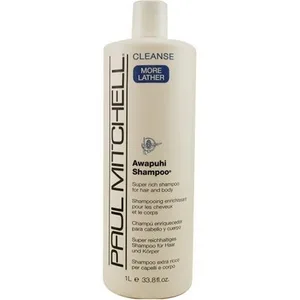
Paul Mitchell
Awapuhi Shampoo
hidratacao150mlGTIN 0822142250668
Raters split
Ingredient safety
A 60-point gap between the two loudest voices.
30Greenlens Precautionary ScreenIndependent
vs90EU Harmonised Classification (CLP Annex VI)Government
050100
See why, ingredient by ingredientEvery rater, every axis
Ingredient safety
60 pts apartA government authority. Auto-linked to this product, not yet human-reviewed. Checked this week. about this rater →
Independent — not funded by the brands it rates. Auto-linked to this product, not yet human-reviewed. Checked this week. about this rater →
Independent — not funded by the brands it rates. Auto-linked to this product, not yet human-reviewed. Checked this week. about this rater →
Independent — not funded by the brands it rates. Auto-linked to this product, not yet human-reviewed. Checked this week. about this rater →
A government authority. Auto-linked to this product, not yet human-reviewed. Checked this week. about this rater →
Also screened, nothing found: California Proposition 65 · IARC Monographs · US NTP Report on Carcinogens · ANSES Endocrine Disruptors · ECHA SVHC Candidate List
Environmental
Also screened, nothing found: EU Microplastics Restriction
Labor
raters agreeRun by a nonprofit. Auto-linked to this product, not yet human-reviewed. This rates Paul Mitchell as a company and applies to everything they make, not this product alone. Checked this week. about this rater →
Run by a nonprofit. Auto-linked to this product, not yet human-reviewed. Checked this week. about this rater →
Packaging
Independent — not funded by the brands it rates. Auto-linked to this product, not yet human-reviewed. Checked this week. about this rater →
Coverage & match quality
8 ratings · 3 of 4 axes
- Some ratings rest on an automatic match that has not been human-reviewed.
- Fewer raters reach smaller-brand products, so a missing rating is not a clean bill of health, only a gap.
Weighted by what you care about
Tune your weights
composite recomputes live
+
1.0×
Environmentalno rating
No rater covers this axis for this product, so its weight can't move the score.
1.0×
1.0×
0 means ignored. Higher = more weight in your composite.
What we know about the packaging
Unidentified0 of 1 identified
Nobody recorded what this pack is actually made of beyond “plastic”, so the packaging score is a stand-in for the middle of that range — not a reading of this container.
- Recorded only as “plastic” — no resin code. It could be PET (#1) (widely recyclable) or PVC (#3) (hard to recycle); nothing on record says which, so it counts as 46 out of 100, the middle of that range.
This says how precisely the packaging is described, not how good it is — a fully identified material can still be a bad one.
Ingredients, decoded
Data availability
Robust61 of 67 characterized
Our sources have reference data on 61 of 67 listed ingredients; 6 are uncharacterized in our data — a gap, not a clean bill.
Worth a look (10)
Strong contact sensitizerflagged by 3 of 9 lists →
Strong contact sensitizerflagged by 1 of 9 lists →
Undisclosed fragrance blendflagged by 2 of 9 lists →
Strong contact sensitizerflagged by 2 of 9 lists →
Undisclosed fragrance blendflagged by 2 of 9 lists →
Mild sensitizer for someflagged by 1 of 9 lists →
Health Canada Hotlist — restrictedflagged by 1 of 9 lists →
EU-regulated fragrance allergenflagged by 1 of 9 lists →
EU-restricted (with limits)flagged by 2 of 9 lists
EU-restricted (with limits)flagged by 2 of 9 lists →
No flags in our sources (51)
- Water
- Sodium Laureth Sulfate
- Sodium Lauroyl Sarcosinate
- Disodium Laureth Sulfosuccinate
- Sodium Chloride
- Glycerinhumectant
- PEG-120 Methyl Glucose Dioleate
- Disodium EDTA
- Sodium Benzoate
- Potassium Sorbate
- Hexylene Glycol
- Methyl Gluceth-20
- Tetrasodium EDTA
- Arginine
- Serine
- Glycine
- Glucose
- Superoxide Dismutase
- Sodium PCAhumectant
- Alanine
- Proline
- Threonine
- Isoleucine
- Histidine
- Phenylalanine
- Aspartic Acid
- PCA
- Valine
- Methionine
- Lysine
- Tyrosine
- Leucine
- Tryptophan
- Arctium Lappa Root Extract
- Citrus Aurantium Dulcis Fruit Extract
- Citrus Limon Fruit Extract
- Saccharum Officinarum Extract
- Zingiber Officinale Root Extract
- Citrus Grandis Fruit Extract
- Elettaria Cardamomum Seed Extract
- Euterpe Oleracea Fruit Extract
- Lycium Barbarum Fruit Extract
- Oryza Sativa
- Panthenolhumectantsoothing
- Tocopheryl Acetate
- Helianthus Annuus Seed Oil
- Butylene Glycol
- Aqua
- Lemon
- Ginger
- Sunflower
No data in our sources (6)
Not a verdict — our authorities simply have no reference for these.
What these ingredient tags mean (4)
These describe what an ingredient is, not whether it is a problem. The stance marks above are the ratings; these are not.
common irritantCocamidopropyl Betaine, Methylchloroisothiazolinone, Methylisothiazolinone
- Cocamidopropyl Betaine: A mild cleansing agent, but a recurring patch-test finding, usually traced to leftovers from how it is made. American Contact Dermatitis Society, Allergen of the Year 2004 (Fowler JF Jr, Dermatitis 2004;15(1):3-4).
- Methylchloroisothiazolinone: A preservative restricted to rinse-off products in the EU because of contact-allergy reports. EU Regulation (EC) 1223/2009, Annex V entry 39 (rinse-off only, 0,0015% of a 3:1 mixture with methylisothiazolinone). The reason is in Commission Regulation (EU) No 1003/2014, recital 3, quoted rather than summarised: "The SCCS concluded that the mixture of Methylchloroisothiazolinone (and) Methylisothiazolinone in a ratio of 3:1 does not pose a risk to the health of the consumer when used as a preservative up to a maximum authorised concentration of 0,0015 % in rinse-off cosmetic products, apart from its skin sensitising potential. The SCCS indicated that induction and elicitation would be less likely in a rinse-off product than when the same concentration is present in a leave-on product." SCCS/1238/09 concludes it "is well recognised as an important skin sensitiser at current conditions of use".
- Methylisothiazolinone: A preservative that patch-test clinics see reactions to often enough that the EU banned it from leave-on products. American Contact Dermatitis Society, Allergen of the Year 2013 (Castanedo-Tardana MP, Zug KA, Dermatitis 2013;24(1):2-6); SCCS Opinion on Methylisothiazolinone (P94), Submission II, SENSITISATION ONLY (SCCS/1521/13, revision of 27 March 2014); banned in leave-on cosmetics by Commission Regulation (EU) 2016/1198, which recites the need to address "the increased incidence of allergies induced by methylisothiazolinone".
undeclared fragrance blendFragrance
- Fragrance: A blend the label does not itemize, so what is in it cannot be read from the ingredient list. EU Regulation (EC) 1223/2009 permits the collective term "parfum"; the SCCS Opinion on Fragrance Allergens (SCCS/1459/11) reviews the contact-allergy evidence for the substances it can contain.
humectantGlycerin, Sodium PCA, Panthenol
- Glycerin: A humectant, and one of the two ingredients a comparison of moisturiser components found made a significant difference to skin hydration. FDA OTC skin protectant monograph, 21 CFR 347.10(h), lists glycerin as a skin protectant at 20 to 45%. On the humectant half: Jeong CB, Han JY, Cho JC, Suh KD, Nam GW, "Analysis of electrical property changes of skin by oil-in-water emulsion components", Int J Cosmet Sci 2013;35(4):402-410, DOI 10.1111/ics.12059, PMID 23621673, found that "glycerine and urea showed significant skin hydration effects compared with other humectants".
- Sodium PCA: The salt of PCA, one of the water-holding substances the outer layer of skin makes for itself. Dörner C, Steinbinder J, Sachslehner AP, Sukseree S, Eckhart L, "Amino Acid Metabolism of the Skin: Control by Specific Enzymes and Contribution to Protective Functions", Metabolites 2025;15(9):601, DOI 10.3390/metabo15090601, open access, section "Glutamine Is Converted to Pyrrolidone Carboxylic Acid, a Component of the NMF": "pyrrolidone carboxylic acid (PCA), also known as pyroglutamic acid or 5-oxoproline, accumulates in the stratum corneum."
- Panthenol: A provitamin B5 humectant used in products aimed at irritated and healing skin. On the humectant half: Ferreira VTP, Silva GC, Martin AA, Maia Campos PMBG, "Topical dexpanthenol effects on physiological parameters of the stratum corneum by Confocal Raman Microspectroscopy", Skin Res Technol 2023;29(9):e13317, DOI 10.1111/srt.13317, PMID 37753694, PMCID PMC10504581, open access, Introduction: "As a humectant, it has been shown to retain water more efficiently than other humectants during the last stages of dehydration..." On the soothing half, which that paper does NOT support: Cho YS, Kim HO, Woo SM, Lee DH, "Use of Dexpanthenol for Atopic Dermatitis—Benefits and Recommendations Based on Current Evidence", J Clin Med 2022;11(14):3943, DOI 10.3390/jcm11143943, PMID 35887707, open access, section 3.5: "To facilitate wound healing, dexpanthenol reduces inflammation, and promotes cell proliferation and epithelial remodeling."
soothingPanthenol
- Panthenol: A provitamin B5 humectant used in products aimed at irritated and healing skin. On the humectant half: Ferreira VTP, Silva GC, Martin AA, Maia Campos PMBG, "Topical dexpanthenol effects on physiological parameters of the stratum corneum by Confocal Raman Microspectroscopy", Skin Res Technol 2023;29(9):e13317, DOI 10.1111/srt.13317, PMID 37753694, PMCID PMC10504581, open access, Introduction: "As a humectant, it has been shown to retain water more efficiently than other humectants during the last stages of dehydration..." On the soothing half, which that paper does NOT support: Cho YS, Kim HO, Woo SM, Lee DH, "Use of Dexpanthenol for Atopic Dermatitis—Benefits and Recommendations Based on Current Evidence", J Clin Med 2022;11(14):3943, DOI 10.3390/jcm11143943, PMID 35887707, open access, section 3.5: "To facilitate wound healing, dexpanthenol reduces inflammation, and promotes cell proliferation and epithelial remodeling."
Where this came from
Cruelty-free status recorded from crueltyfree.peta.org ↗
Researched facts on Greenlens always carry the page that stated them — nothing is inferred from a model's memory.