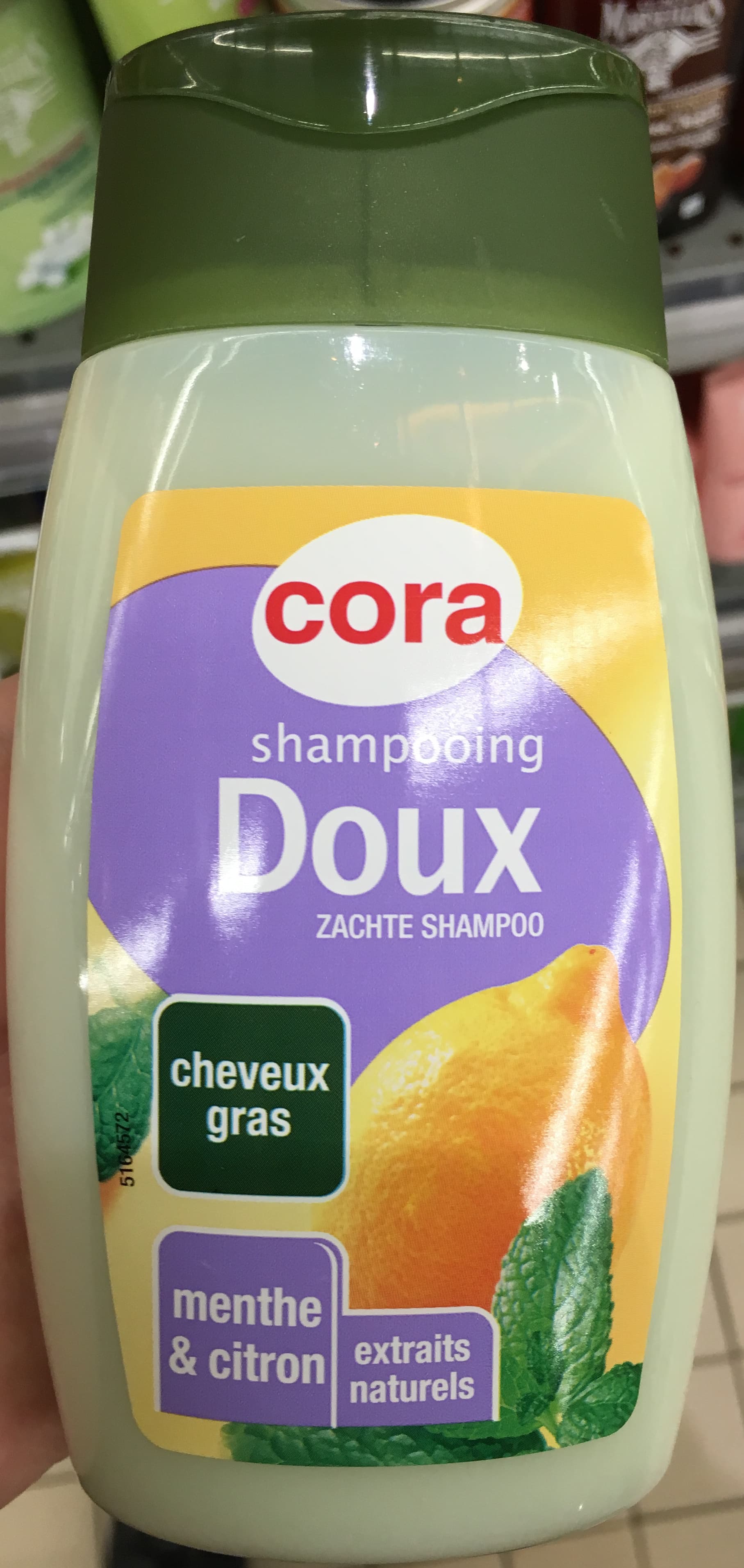
Cora
Gentle Shampoo for Oily Hair Mint & Lemon
shampoos for oily hair250mlGTIN 3257982124997

Cleaner pick · Safest cleansing we have rated
Africology Skincare & Spa
Bio Therapy Conditioner+47 on ingredient safety, gives up 14 on packaging
250ml · 47.50 ZAR · 19 ZAR/100 ml
Ingredient safetyRaters agree
Ranked by safety only. Greenlens earns from qualifying purchases. Payout never affects a rating, a ranking, or the cleaner pick.
Raters split
Ingredient safety
A 46-point gap between the two loudest voices.
42Greenlens Precautionary ScreenIndependent
vs88Greenlens Tolerance ScreenIndependent
050100
See why, ingredient by ingredientAll 6967 cleaner options, safest first We show the best 12, including the strongest on each axis.
Every rater, every axis
Ingredient safety
46 pts apartA government authority. Auto-linked to this product, not yet human-reviewed. Checked this week. about this rater →
Independent — not funded by the brands it rates. Auto-linked to this product, not yet human-reviewed. Checked this week. about this rater →
Independent — not funded by the brands it rates. Auto-linked to this product, not yet human-reviewed. Checked this week. about this rater →
A government authority. Auto-linked to this product, not yet human-reviewed. Checked this week. about this rater →
Independent — not funded by the brands it rates. Auto-linked to this product, not yet human-reviewed. Checked this week. about this rater →
A government authority. Auto-linked to this product, not yet human-reviewed. Checked this week. about this rater →
Also screened, nothing found: California Proposition 65 · IARC Monographs · US NTP Report on Carcinogens · ECHA SVHC Candidate List
Environmental
A government authority. Auto-linked to this product, not yet human-reviewed. Checked this week. about this rater →
Labor
Run by a nonprofit. Auto-linked to this product, not yet human-reviewed. This rates Cora as a company and applies to everything they make, not this product alone. Checked this week. about this rater →
Packaging
Independent — not funded by the brands it rates. Auto-linked to this product, not yet human-reviewed. Checked this week. about this rater →
Coverage & match quality
9 ratings · 4 of 4 axes
- Some ratings rest on an automatic match that has not been human-reviewed.
Weighted by what you care about
Tune your weights
composite recomputes live
+
1.0×
1.0×
1.0×
1.0×
0 means ignored. Higher = more weight in your composite.
What we know about the packaging
Unidentified0 of 1 identified
Nobody recorded what this pack is actually made of beyond “plastic”, so the packaging score is a stand-in for the middle of that range — not a reading of this container.
- Recorded only as “plastic” — no resin code. It could be PET (#1) (widely recyclable) or PVC (#3) (hard to recycle); nothing on record says which, so it counts as 46 out of 100, the middle of that range.
This says how precisely the packaging is described, not how good it is — a fully identified material can still be a bad one.
Ingredients, decoded
Data availability
Robust29 of 30 characterized
Our sources have reference data on 29 of 30 listed ingredients; 1 is uncharacterized in our data — a gap, not a clean bill.
Worth a look (11)
ANSES endocrine candidateflagged by 3 of 9 lists →
Strong contact sensitizerflagged by 3 of 9 lists →
Strong contact sensitizerflagged by 1 of 9 lists →
Undisclosed fragrance blendflagged by 2 of 9 lists →
EU harmonised skin sensitizerflagged by 2 of 9 lists →
Strong contact sensitizerflagged by 2 of 9 lists →
EU microplastics-restrictedflagged by 1 of 9 lists →
Health Canada Hotlist — restrictedflagged by 1 of 9 lists →
Transparency concernflagged by 1 of 9 lists →
EU-restricted (with limits)flagged by 2 of 9 lists →
EU-restricted (with limits)flagged by 2 of 9 lists →
No flags in our sources (18)
- water
- SODIUM LAURETH SULFATE
- sodium chloride
- PEG-60 _ALMOND_ GLYCERIDES
- GLYCERINhumectant
- PANTHENOLhumectantsoothing
- PROPYLENE GLYCOLcommon irritant
- TETRASODIUM EDTA
- POTASSIUM SORBATE
- TRIDECETH-7
- CITRUS LIMON FRUIT EXTRACT
- PANTOLACTONE
- ERUCA SATIVA LEAF EXTRACT
- HEDERA HELIX LEAF STEM EXTRACT
- NASTURTIUM OFFICINALE FLOWER LEAF EXTRACT
- SODIUM BENZOATE
- MENTHA ARVENSIS LEAF OIL
- CI 47005
No data in our sources (1)
Not a verdict — our authorities simply have no reference for these.
What these ingredient tags mean (5)
These describe what an ingredient is, not whether it is a problem. The stance marks above are the ratings; these are not.
common irritantCOCAMIDOPROPYL BETAINE, PROPYLENE GLYCOL, SODIUM LAURYL SULFATE, METHYLCHLOROISOTHIAZOLINONE, METHYLISOTHIAZOLINONE
- COCAMIDOPROPYL BETAINE: A mild cleansing agent, but a recurring patch-test finding, usually traced to leftovers from how it is made. American Contact Dermatitis Society, Allergen of the Year 2004 (Fowler JF Jr, Dermatitis 2004;15(1):3-4).
- PROPYLENE GLYCOL: A solvent that shows up in patch-test clinics, more often as irritation than as allergy. American Contact Dermatitis Society, Allergen of the Year 2018 (Jacob SE, Scheman A, McGowan MA, Dermatitis 2018;29(1):3-5).
- SODIUM LAURYL SULFATE: A strong cleansing agent used as the reference irritant in skin-irritation testing. OECD Test Guideline 439 (in vitro skin irritation, reconstructed human epidermis), paragraph 24: "The suggested PC is 5% aqueous SDS", sodium dodecyl sulphate, the same substance as sodium lauryl sulfate, CAS 151-21-3.
- METHYLCHLOROISOTHIAZOLINONE: A preservative restricted to rinse-off products in the EU because of contact-allergy reports. EU Regulation (EC) 1223/2009, Annex V entry 39 (rinse-off only, 0,0015% of a 3:1 mixture with methylisothiazolinone). The reason is in Commission Regulation (EU) No 1003/2014, recital 3, quoted rather than summarised: "The SCCS concluded that the mixture of Methylchloroisothiazolinone (and) Methylisothiazolinone in a ratio of 3:1 does not pose a risk to the health of the consumer when used as a preservative up to a maximum authorised concentration of 0,0015 % in rinse-off cosmetic products, apart from its skin sensitising potential. The SCCS indicated that induction and elicitation would be less likely in a rinse-off product than when the same concentration is present in a leave-on product." SCCS/1238/09 concludes it "is well recognised as an important skin sensitiser at current conditions of use".
- METHYLISOTHIAZOLINONE: A preservative that patch-test clinics see reactions to often enough that the EU banned it from leave-on products. American Contact Dermatitis Society, Allergen of the Year 2013 (Castanedo-Tardana MP, Zug KA, Dermatitis 2013;24(1):2-6); SCCS Opinion on Methylisothiazolinone (P94), Submission II, SENSITISATION ONLY (SCCS/1521/13, revision of 27 March 2014); banned in leave-on cosmetics by Commission Regulation (EU) 2016/1198, which recites the need to address "the increased incidence of allergies induced by methylisothiazolinone".
fragrance materialBENZYL ALCOHOL, LIMONENE
- BENZYL ALCOHOL: Used both as a fragrance component and as a preservative; the EU names it either way. EU Regulation (EC) 1223/2009, Annex III entry 45: a fragrance substance whose presence must be indicated in the list of ingredients above 0,001% in leave-on and 0,01% in rinse-off products, because of established contact-allergy risk. That entry carries transition footnote (38), which is footnote (37) plus a condition: stock that does not comply may still be made available until 31 July 2028 only "provided that they comply with the restrictions applicable on 15 August 2023", and only if it was lawfully placed on the Union market before the 31 July 2026 cut-off. Entry 45 covers its non-preservative use; it is separately an allowed preservative at Annex V entry 34.
- LIMONENE: A citrus-smelling fragrance component named separately on the label; the one name covers three related isomers. EU Regulation (EC) 1223/2009, Annex III entry 88: a fragrance substance whose presence must be indicated in the list of ingredients above 0,001% in leave-on and 0,01% in rinse-off products, because of established contact-allergy risk. That entry carries transition footnote (37): stock that does not comply, lawfully placed on the Union market before the 31 July 2026 cut-off, may still be made available until 31 July 2028. It is marked on the racemic dl-limonene/Dipentene line and the (S)-(l-limonene) line, but NOT the (R)-p-mentha-1,8-diene (d-limonene) line, CAS 5989-27-5, whose duty was already running as entry 88 before Commission Regulation (EU) 2023/1545 and so needed no transition. All three isomers are declared under the single glossary name "Limonene", so that name on a label does not identify which of them is present.
undeclared fragrance blendPARFUM
- PARFUM: A blend the label does not itemize, so what is in it cannot be read from the ingredient list. EU Regulation (EC) 1223/2009 permits the collective term "parfum"; the SCCS Opinion on Fragrance Allergens (SCCS/1459/11) reviews the contact-allergy evidence for the substances it can contain.
humectantGLYCERIN, PANTHENOL
- GLYCERIN: A humectant, and one of the two ingredients a comparison of moisturiser components found made a significant difference to skin hydration. FDA OTC skin protectant monograph, 21 CFR 347.10(h), lists glycerin as a skin protectant at 20 to 45%. On the humectant half: Jeong CB, Han JY, Cho JC, Suh KD, Nam GW, "Analysis of electrical property changes of skin by oil-in-water emulsion components", Int J Cosmet Sci 2013;35(4):402-410, DOI 10.1111/ics.12059, PMID 23621673, found that "glycerine and urea showed significant skin hydration effects compared with other humectants".
- PANTHENOL: A provitamin B5 humectant used in products aimed at irritated and healing skin. On the humectant half: Ferreira VTP, Silva GC, Martin AA, Maia Campos PMBG, "Topical dexpanthenol effects on physiological parameters of the stratum corneum by Confocal Raman Microspectroscopy", Skin Res Technol 2023;29(9):e13317, DOI 10.1111/srt.13317, PMID 37753694, PMCID PMC10504581, open access, Introduction: "As a humectant, it has been shown to retain water more efficiently than other humectants during the last stages of dehydration..." On the soothing half, which that paper does NOT support: Cho YS, Kim HO, Woo SM, Lee DH, "Use of Dexpanthenol for Atopic Dermatitis—Benefits and Recommendations Based on Current Evidence", J Clin Med 2022;11(14):3943, DOI 10.3390/jcm11143943, PMID 35887707, open access, section 3.5: "To facilitate wound healing, dexpanthenol reduces inflammation, and promotes cell proliferation and epithelial remodeling."
soothingPANTHENOL
- PANTHENOL: A provitamin B5 humectant used in products aimed at irritated and healing skin. On the humectant half: Ferreira VTP, Silva GC, Martin AA, Maia Campos PMBG, "Topical dexpanthenol effects on physiological parameters of the stratum corneum by Confocal Raman Microspectroscopy", Skin Res Technol 2023;29(9):e13317, DOI 10.1111/srt.13317, PMID 37753694, PMCID PMC10504581, open access, Introduction: "As a humectant, it has been shown to retain water more efficiently than other humectants during the last stages of dehydration..." On the soothing half, which that paper does NOT support: Cho YS, Kim HO, Woo SM, Lee DH, "Use of Dexpanthenol for Atopic Dermatitis—Benefits and Recommendations Based on Current Evidence", J Clin Med 2022;11(14):3943, DOI 10.3390/jcm11143943, PMID 35887707, open access, section 3.5: "To facilitate wound healing, dexpanthenol reduces inflammation, and promotes cell proliferation and epithelial remodeling."
Where this came from
Cruelty-free status recorded from leapingbunny.org ↗
Researched facts on Greenlens always carry the page that stated them — nothing is inferred from a model's memory.