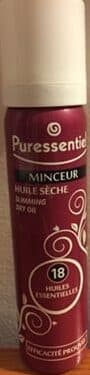
Puressentiel
Slimming Dry Oil
soins corporels100mlGTIN 3401360266766
Raters split
Ingredient safety
A 100-point gap between the two loudest voices.
0ANSES Endocrine DisruptorsGovernment
vs100Greenlens Precautionary ScreenIndependent
050100
See why, ingredient by ingredientEvery rater, every axis
Ingredient safety
100 pts apartIndependent — not funded by the brands it rates. Auto-linked to this product, not yet human-reviewed. Checked this week. about this rater →
Independent — not funded by the brands it rates. Auto-linked to this product, not yet human-reviewed. Checked this week. about this rater →
A government authority. Auto-linked to this product, not yet human-reviewed. Checked this week. about this rater →
A government authority. Auto-linked to this product, not yet human-reviewed. Checked this week. about this rater →
Independent — not funded by the brands it rates. Auto-linked to this product, not yet human-reviewed. Checked this week. about this rater →
Also screened, nothing found: California Proposition 65 · ECHA SVHC Candidate List · US NTP Report on Carcinogens · Health Canada Ingredient Hotlist · IARC Monographs
Environmental
Also screened, nothing found: EU Microplastics Restriction
Packaging
Independent — not funded by the brands it rates. Auto-linked to this product, not yet human-reviewed. Checked this week. about this rater →
Coverage & match quality
6 ratings · 2 of 4 axes
- Some ratings rest on an automatic match that has not been human-reviewed.
- Fewer raters reach smaller-brand products, so a missing rating is not a clean bill of health, only a gap.
Weighted by what you care about
Tune your weights
composite recomputes live
+
1.0×
Environmentalno rating
No rater covers this axis for this product, so its weight can't move the score.
Laborno rating
No rater covers this axis for this product, so its weight can't move the score.
1.0×
0 means ignored. Higher = more weight in your composite.
What we know about the packaging
Unidentified0 of 2 identified
None of the 2 packaging components is identified beyond its broad material, so the packaging score is a stand-in — not a reading of this container.
- Recorded only as “plastic” — no resin code. It could be PET (#1) (widely recyclable) or PVC (#3) (hard to recycle); nothing on record says which, so it counts as 46 out of 100, the middle of that range.
This says how precisely the packaging is described, not how good it is — a fully identified material can still be a bad one.
How we know the packaging
Nobody published the material for this product, so it was read from the product photo — the container looks like this, rather than the maker saying so. Treat the packaging score as weaker here than on a product with a declared material.
A photo also cannot show the resin code moulded into the base, so every plastic container reads as “plastic, unspecified” — the cautious end of the plastics range, not a finding about this particular pack.
Ingredients, decoded
Data availability
Robust44 of 48 characterized
Our sources have reference data on 44 of 48 listed ingredients; 4 are uncharacterized in our data — a gap, not a clean bill.
Worth a look (18)
ANSES endocrine candidateflagged by 3 of 9 lists →
ANSES endocrine candidateflagged by 3 of 9 lists →
ANSES endocrine candidateflagged by 3 of 9 lists →
ANSES endocrine candidateflagged by 3 of 9 lists →
EU harmonised skin sensitizerflagged by 2 of 9 lists →
EU harmonised skin sensitizerflagged by 2 of 9 lists →
ANSES endocrine candidateflagged by 2 of 9 lists →
ANSES endocrine candidateflagged by 2 of 9 lists →
ANSES endocrine candidateflagged by 2 of 9 lists →
EU harmonised skin sensitizerflagged by 2 of 9 lists →
ANSES endocrine candidateflagged by 2 of 9 lists →
EU-regulated fragrance allergenflagged by 1 of 9 lists →
EU-regulated fragrance allergenflagged by 1 of 9 lists →
EU-regulated fragrance allergenflagged by 1 of 9 lists →
EU-regulated fragrance allergenflagged by 1 of 9 lists →
EU-regulated fragrance allergenflagged by 1 of 9 lists →
EU-regulated fragrance allergenflagged by 1 of 9 lists →
EU-regulated fragrance allergenflagged by 1 of 9 lists →
No flags in our sources (26)
- CETEARYL ETHYLHEXANOATE
- DIBUTYL ADIPATE
- CETEARYL ISONONANOATE
- DICAPRYLYL ETHER
- SIMMONDSIA CHINENSIS SEED OIL
- VITIS VINIFERA SEED OIL
- MACADAMIA TERNIFOLIA SEED OIL
- CITRUS PARADISI PEEL OILfragrance material
- ORYZA SATIVA BRAN OIL
- CORYLUS AVELLANA SEED OIL
- ROSMARINUS OFFICINALIS LEAF OILfragrance material
- MELALEUCA VIRIDIFLORA LEAF OIL
- CITRUS NOBILIS PEEL OIL
- VETIVERIA ZIZANOIDES ROOT OIL
- FOENICULUM VULGARE OIL
- HELIANTHUS ANNUUS SEED OIL
- AMYRIS BALSAMIFERA BARK OILfragrance material
- FOENICULUM VULGARE SEED EXTRACT
- GAULTHERIA PROCUMBENS LEAF OIL
- CHAMOMILLA RECUTITA FLOWER EXTRACT
- CARUM PETROSELINUM SEED OIL
- SALVIA OFFICINALIS OILfragrance material
- TOCOPHEROL
- CITRUS AURANTIUM DULCIS PEEL OILfragrance material
- JUNIPERUS COMMUNIS WOOD OIL
- ACHILLEA MILLEFOLIUM EXTRACT
No data in our sources (4)
Not a verdict — our authorities simply have no reference for these.
What these ingredient tags mean (1)
These describe what an ingredient is, not whether it is a problem. The stance marks above are the ratings; these are not.
fragrance materialLIMONENE, CITRUS LIMON PEEL OIL, LINALOOL, CITRAL, GERANIOL, BENZYL BENZOATE, CITRONELLOL, CINNAMAL, BENZYL SALICYLATE, FARNESOL, EUGENOL, ISOEUGENOL, BENZYL ALCOHOL, CINNAMYL ALCOHOL
- LIMONENE: A citrus-smelling fragrance component named separately on the label; the one name covers three related isomers. EU Regulation (EC) 1223/2009, Annex III entry 88: a fragrance substance whose presence must be indicated in the list of ingredients above 0,001% in leave-on and 0,01% in rinse-off products, because of established contact-allergy risk. That entry carries transition footnote (37): stock that does not comply, lawfully placed on the Union market before the 31 July 2026 cut-off, may still be made available until 31 July 2028. It is marked on the racemic dl-limonene/Dipentene line and the (S)-(l-limonene) line, but NOT the (R)-p-mentha-1,8-diene (d-limonene) line, CAS 5989-27-5, whose duty was already running as entry 88 before Commission Regulation (EU) 2023/1545 and so needed no transition. All three isomers are declared under the single glossary name "Limonene", so that name on a label does not identify which of them is present.
- CITRUS LIMON PEEL OIL: A citrus peel oil the EU names on its own account as a fragrance substance to be declared on the label. EU Regulation (EC) 1223/2009, Annex III entry 353, inserted by Commission Regulation (EU) 2023/1545: a fragrance substance whose presence must be indicated in the list of ingredients above 0,001% in leave-on and 0,01% in rinse-off products. It is declarable in its OWN right, not by way of any component it carries. The name to look for on a label is "Citrus Limon Peel Oil". The duty applies now. Transition footnote (40) lets stock that does not comply, lawfully placed on the Union market before the 31 July 2026 cut-off, be made available until 31 July 2028.
- LINALOOL: A floral fragrance component named separately on the label. EU Regulation (EC) 1223/2009, Annex III entry 84: a fragrance substance whose presence must be indicated in the list of ingredients above 0,001% in leave-on and 0,01% in rinse-off products, because of established contact-allergy risk.
- CITRAL: A lemon-scented fragrance component named separately on the label; the one name covers three related substances. EU Regulation (EC) 1223/2009, Annex III entry 70: a fragrance substance whose presence must be indicated in the list of ingredients above 0,001% in leave-on and 0,01% in rinse-off products, because of established contact-allergy risk. As replaced by Commission Regulation (EU) 2026/909 of 27 April 2026, the entry is a GROUPED one covering citral, geranial and neral, declared collectively as "Citral", with per-product-type caps from 0,032% in deodorant to 1,2% in rinse-off and leave-on hair products. Its three substances carry two different sell-through dates: products not complying may not be placed on the Union market from 1 January 2027 in every case, and may not be made available from 1 July 2028 for citral, footnote (**), or from 1 August 2028 for geranial and neral, footnote (***). In the consolidated text those two footnotes are renumbered (46) and (47); both are worded "these substances", where the footnotes that attach to a single named substance say "that substance".
- GERANIOL: A rose-scented fragrance component named separately on the label. EU Regulation (EC) 1223/2009, Annex III entry 78: a fragrance substance whose presence must be indicated in the list of ingredients above 0,001% in leave-on and 0,01% in rinse-off products, because of established contact-allergy risk.
- BENZYL BENZOATE: A balsamic fragrance component named separately on the label. EU Regulation (EC) 1223/2009, Annex III entry 85: a fragrance substance whose presence must be indicated in the list of ingredients above 0,001% in leave-on and 0,01% in rinse-off products, because of established contact-allergy risk.
- CITRONELLOL: A rose-and-citrus fragrance component named separately on the label. EU Regulation (EC) 1223/2009, Annex III entry 86: a fragrance substance whose presence must be indicated in the list of ingredients above 0,001% in leave-on and 0,01% in rinse-off products, because of established contact-allergy risk.
- CINNAMAL: A cinnamon-scented fragrance component named separately on the label. EU Regulation (EC) 1223/2009, Annex III entry 76: a fragrance substance whose presence must be indicated in the list of ingredients above 0,001% in leave-on and 0,01% in rinse-off products, because of established contact-allergy risk.
- BENZYL SALICYLATE: A faintly floral fragrance component named separately on the label. EU Regulation (EC) 1223/2009, Annex III entry 75: a fragrance substance whose presence must be indicated in the list of ingredients above 0,001% in leave-on and 0,01% in rinse-off products, because of established contact-allergy risk. The entry was replaced by Commission Regulation (EU) 2026/909 of 27 April 2026, which caps it per product type from 0,004% in oral products to 4% in fragrance products; under its footnote (**), products not complying may not be placed on the Union market from 1 January 2027, nor made available from 1 July 2028.
- FARNESOL: A soft floral fragrance component named separately on the label. EU Regulation (EC) 1223/2009, Annex III entry 82: a fragrance substance whose presence must be indicated in the list of ingredients above 0,001% in leave-on and 0,01% in rinse-off products, because of established contact-allergy risk.
- EUGENOL: A clove-scented fragrance component named separately on the label. EU Regulation (EC) 1223/2009, Annex III entry 71: a fragrance substance whose presence must be indicated in the list of ingredients above 0,001% in leave-on and 0,01% in rinse-off products, because of established contact-allergy risk.
- ISOEUGENOL: A clove-scented fragrance component named separately on the label. EU Regulation (EC) 1223/2009, Annex III entry 73: a fragrance substance whose presence must be indicated in the list of ingredients above 0,001% in leave-on and 0,01% in rinse-off products, because of established contact-allergy risk.
- BENZYL ALCOHOL: Used both as a fragrance component and as a preservative; the EU names it either way. EU Regulation (EC) 1223/2009, Annex III entry 45: a fragrance substance whose presence must be indicated in the list of ingredients above 0,001% in leave-on and 0,01% in rinse-off products, because of established contact-allergy risk. That entry carries transition footnote (38), which is footnote (37) plus a condition: stock that does not comply may still be made available until 31 July 2028 only "provided that they comply with the restrictions applicable on 15 August 2023", and only if it was lawfully placed on the Union market before the 31 July 2026 cut-off. Entry 45 covers its non-preservative use; it is separately an allowed preservative at Annex V entry 34.
- CINNAMYL ALCOHOL: A cinnamon-scented fragrance component named separately on the label. EU Regulation (EC) 1223/2009, Annex III entry 69: a fragrance substance whose presence must be indicated in the list of ingredients above 0,001% in leave-on and 0,01% in rinse-off products, because of established contact-allergy risk.