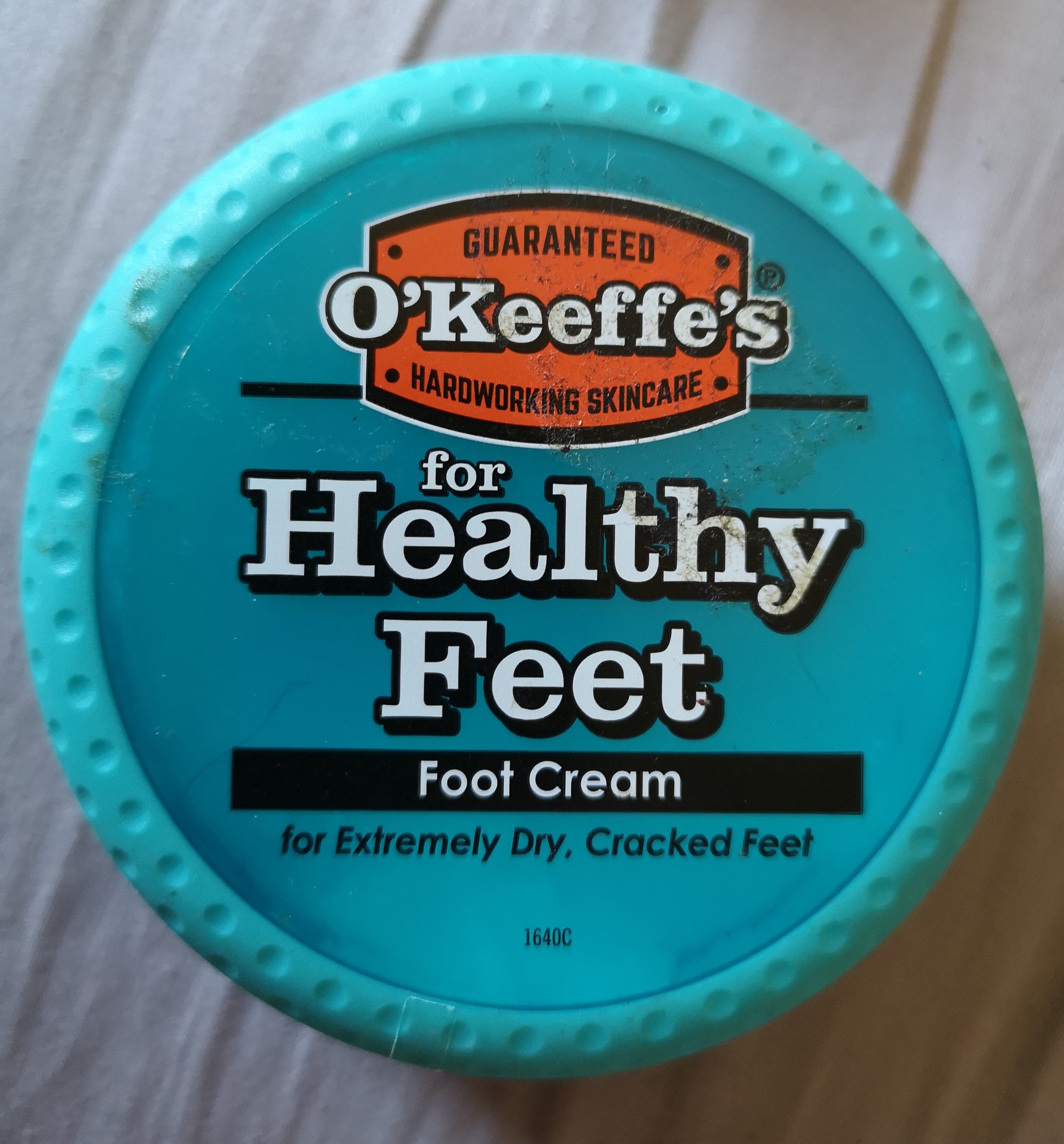
O'Keeffe's
Healthy Feet
Foot cream91gGTIN 5704947004385

Cleaner pick · Safest hands & feet we have rated
Round Lab
Birch Moisturizing Hand Cream+52 on ingredient safety
$8.50
Ingredient safetyRaters agree
Ranked by safety only. Greenlens earns from qualifying purchases. Payout never affects a rating, a ranking, or the cleaner pick.
Raters split
Ingredient safety
A 65-point gap between the two loudest voices.
25Greenlens Precautionary ScreenIndependent
vs90EU Harmonised Classification (CLP Annex VI)Government
050100
See why, ingredient by ingredientAll 2155 cleaner options, safest first We show the best 12, including the strongest on each axis.
Every rater, every axis
Ingredient safety
65 pts apartIndependent — not funded by the brands it rates. Auto-linked to this product, not yet human-reviewed. Checked this week. about this rater →
Independent — not funded by the brands it rates. Auto-linked to this product, not yet human-reviewed. Checked this week. about this rater →
A government authority. Auto-linked to this product, not yet human-reviewed. Checked this week. about this rater →
Independent — not funded by the brands it rates. Auto-linked to this product, not yet human-reviewed. Checked this week. about this rater →
Also screened, nothing found: ECHA SVHC Candidate List · California Proposition 65 · ANSES Endocrine Disruptors · US NTP Report on Carcinogens · Health Canada Ingredient Hotlist · IARC Monographs
Recognized on a safer-ingredients list: US EPA Safer Choice recognizes 63% of ingredients as safer choices — a marker, never a score.
Environmental
Also screened, nothing found: EU Microplastics Restriction
Packaging
Independent — not funded by the brands it rates. Auto-linked to this product, not yet human-reviewed. Checked this week. about this rater →
Coverage & match quality
5 ratings · 2 of 4 axes
- Some ratings rest on an automatic match that has not been human-reviewed.
- Fewer raters reach smaller-brand products, so a missing rating is not a clean bill of health, only a gap.
Weighted by what you care about
Tune your weights
composite recomputes live
+
1.0×
Environmentalno rating
No rater covers this axis for this product, so its weight can't move the score.
Laborno rating
No rater covers this axis for this product, so its weight can't move the score.
1.0×
0 means ignored. Higher = more weight in your composite.
What we know about the packaging
Unidentified0 of 1 identified
Nobody recorded what this pack is actually made of beyond “plastic”, so the packaging score is a stand-in for the middle of that range — not a reading of this container.
- Recorded only as “plastic” — no resin code. It could be PET (#1) (widely recyclable) or PVC (#3) (hard to recycle); nothing on record says which, so it counts as 46 out of 100, the middle of that range.
This says how precisely the packaging is described, not how good it is — a fully identified material can still be a bad one.
Ingredients, decoded
Data availability
Robust16 of 16 characterized
Our sources have reference data on all 16 listed ingredients.
Worth a look (4)
Carcinogen-linkedflagged by 1 of 9 lists →
EU harmonised skin sensitizerflagged by 1 of 9 lists →
EU-restricted (with limits)flagged by 2 of 9 lists →
EU-restricted (with limits)flagged by 2 of 9 lists →
No flags in our sources (12)
What these ingredient tags mean (4)
These describe what an ingredient is, not whether it is a problem. The stance marks above are the ratings; these are not.
common irritantDiazolidinyl Urea
- Diazolidinyl Urea: A preservative the FDA lists as a formaldehyde releaser, so formaldehyde-reactive skin can notice it. How much reaches the skin depends on the whole formula, not on this name alone. EU Regulation (EC) 1223/2009, Annex V entry 46, permits diazolidinyl urea as a preservative up to 0,5%. The FDA names it among the "formaldehyde and formaldehyde releasing ingredients" on its Allergens in Cosmetics page (content current 25 February 2022). Annex V preamble point 2, as amended by Commission Regulation (EU) 2022/1181, requires the warning "releases formaldehyde" on any product whose total released formaldehyde exceeds 0,001% (10 ppm). That Regulation states the sensitisation ground itself, so the chain is drawn by the regulator and not by us: recital (2) names the class, "Certain of those preservatives are gradually releasing formaldehyde in order to fulfil a preserving function in the final cosmetic product (so called formaldehyde releasers)", and recital (3) gives the purpose of the warning, "In order to inform consumers sensitised to formaldehyde about the presence of formaldehyde that may trigger an allergic reaction". Recital (1) records that formaldehyde is classified a skin sensitizer (Category 1) in Part 3 of Annex VI to Regulation (EC) 1272/2008.
rich occlusiveDimethicone, Paraffinum Liquidum
- Dimethicone: A silicone that forms a film on the surface of the skin without an oily feel. FDA OTC skin protectant monograph, 21 CFR 347.10(g), lists dimethicone as a skin protectant at 1 to 30%.
- Paraffinum Liquidum: A refined oil that sits on the surface of the skin; it has a heavy finish. FDA OTC skin protectant monograph, 21 CFR 347.10(l): "Mineral oil, 50 to 100 percent; 30 to 35 percent in combination with colloidal oatmeal in accordance with 347.20(a)(4)."
humectantGlycerin
- Glycerin: A humectant, and one of the two ingredients a comparison of moisturiser components found made a significant difference to skin hydration. FDA OTC skin protectant monograph, 21 CFR 347.10(h), lists glycerin as a skin protectant at 20 to 45%. On the humectant half: Jeong CB, Han JY, Cho JC, Suh KD, Nam GW, "Analysis of electrical property changes of skin by oil-in-water emulsion components", Int J Cosmet Sci 2013;35(4):402-410, DOI 10.1111/ics.12059, PMID 23621673, found that "glycerine and urea showed significant skin hydration effects compared with other humectants".
soothingAllantoin
- Allantoin: A skin protectant used at low levels in products aimed at irritated skin. FDA OTC skin protectant monograph, 21 CFR 347.10(a), lists allantoin as a skin-protectant active at 0,5 to 2%. Its labelled indications are 21 CFR 347.50(b)(1), "temporarily protects minor: cuts, scrapes, burns", and (b)(2), which covers chafed, chapped or cracked skin. The monograph does not give it the "minor skin irritation and itching" wording; that one belongs to colloidal oatmeal, sodium bicarbonate and one combination, and to topical starch without the itching half.